



Hello Cointribe! 🚀
Today is Friday, July 25, 2025 and as every day from Tuesday to Saturday, we summarize the latest 24 hours news you shouldn't have missed!
But first…
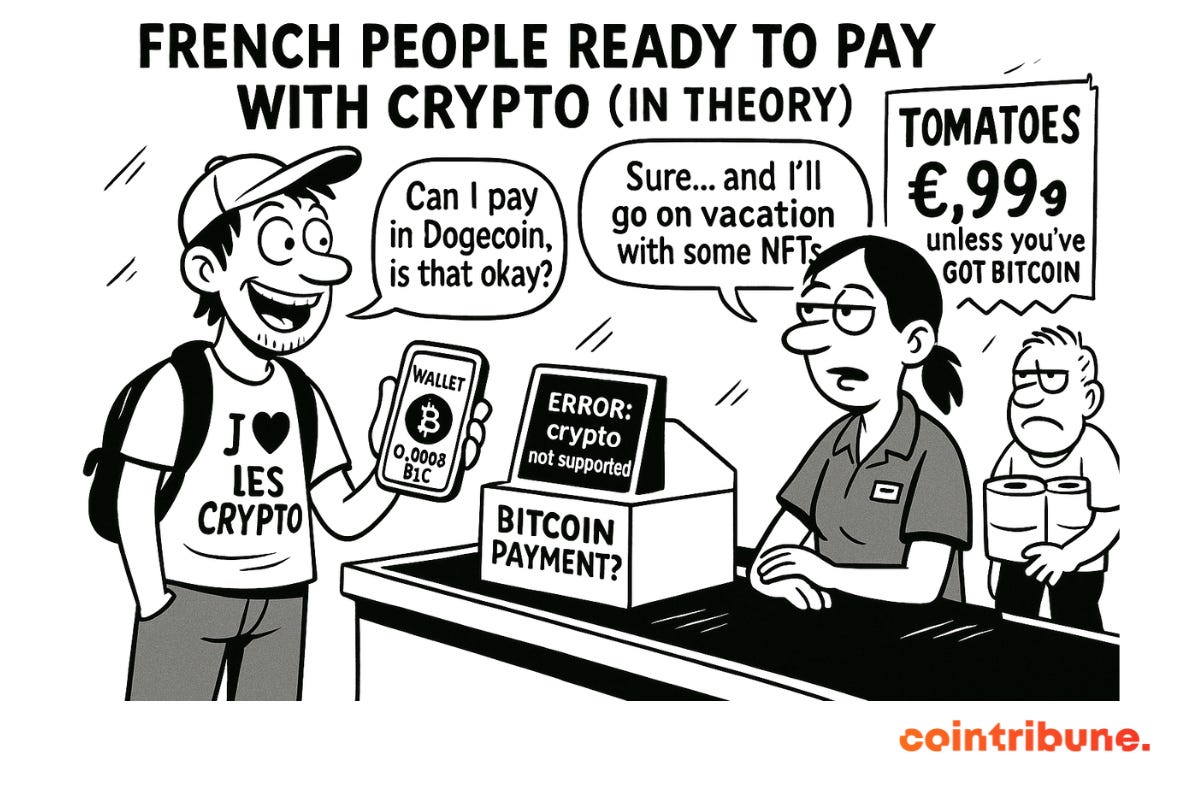
✍️ Cartoon of the day:
A quick look at the market…
🌡 Weather:
🌧️ Rainy
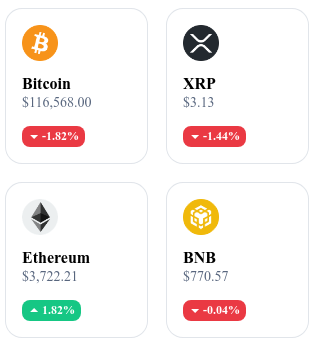

24h crypto recap! ⏱
🏦 JPMorgan prepares crypto-asset-backed loans
JPMorgan plans to authorize from 2026 loans directly backed by Bitcoin or Ethereum, allowing clients to unlock liquidity without selling their digital assets. This initiative represents a major turning point for the bank, long skeptical with Jamie Dimon who once called BTC a "fraud", and highlights the growing normalization of cryptos in traditional finance.
🔄 Chris Larsen under pressure after massive XRP transfer suspected of dumping
Between July 17 and 24, Chris Larsen transferred around 50 million XRP (~140–175 M USD) to exchanges, causing an 8 to 12% drop in XRP price (2.95–2.99 USD). This move occurred at a valuation peak (~3.60 USD) and makes analysts fear a disguised dumping despite the absence of confirmed sale.
🔧 Ethereum is preparing for the Fusaka upgrade in November, Glamsterdam in the making
The network upgrade Fusaka, scheduled for November 2025, will include 11 EIPs aimed at improving scalability, security, and censorship resistance, following the Pectra hard fork. Planning for the next upgrade, Glamsterdam, is also progressing: it could reduce the block time to 6 s and increase the gas limit to 45 M, with a final vote from AllCoreDevs on August 1st.
🇫🇷 64% of French interested in crypto payments according to a survey
A survey conducted in June 2025 among 2,600 people shows that 63.98% of French people interested in crypto plan to buy some soon, while 35.1% consider an investment of €1,000, surpassing those who prefer stocks or real estate. These results are notably concentrated in Occitanie and Grand Est.

Crypto of the day: Litecoin (LTC)
🧠 What innovation & added value?
Created in 2011 by Charlie Lee, Litecoin is one of the very first Bitcoin forks. Its goal: to provide a faster and lighter version of the original cryptocurrency. Thanks to the Scrypt algorithm and a block generation every 2.5 minutes, Litecoin drastically reduces confirmation times while maintaining minimal fees.
The network also includes advanced features such as MWEB (MimbleWimble Extension Block), enabling confidential transactions. Litecoin remains a robust blockchain, often used as a technical testing ground before deployment on Bitcoin (e.g., Lightning Network).
💰 The LTC token: utility, distribution, and benefits
The LTC token has several advantages:
It is used to pay transaction fees, which remain very low.
It allows for testing innovations before adoption by Bitcoin.
It has a capped supply of 84 million tokens, with about 76 million currently in circulation, ensuring some scarcity.
It is highly liquid, available on all major platforms, and used in many wallets and crypto payment solutions.
📊 Recent performances
Current price: $115.39 USD
24h change: +1.36 %
Market capitalization: ≈ 8.79 billion $
CoinMarketCap rank: #18
Circulating supply: 76,112,583 LTC
24h trading volume: ≈ 966 million USD

China turns away from the dollar: Bitcoin in ambush
While the United States is sinking into a spiral of colossal debts, China, the world’s second economy, discreetly but resolutely changes course. By drastically reducing its holdings in US Treasury bonds, Beijing sends a clear signal: the time has come to break with the dollar’s hegemony. This gradual withdrawal from a pillar of the global financial system does not go unnoticed, especially as geopolitical tensions intensify and the BRICS organize to reshape monetary balances.
In this great musical chairs game, an unexpected player joins the table: Bitcoin.
Beijing lightens its dollar reserves, Washington under pressure
China continues its slow but determined dedollarization. In June 2024, its reserves in US Treasury bonds dropped to 765 billion dollars. This level, steadily decreasing for several years, now places Beijing behind the United Kingdom (779 billion) and far behind Japan, the main holder of American debt with 1,111 billion, illustrating a strategic reorientation of China’s monetary policy amid growing tensions with the United States.
Since the 2008 crisis, the share of US debt held by foreign investors has fallen from nearly 60% to only 31%. The US thus sees its ability to finance its budget deficit via foreign sources considerably reduced. This situation is all the more worrying as the Treasury plans expenses exceeding 7,000 billion dollars in 2025, against 5,200 billion in revenues. A structural imbalance that pushes Washington to multiply protectionist measures to stem the dollar hemorrhage, notably in the face of the BRICS’ monetary ambitions.
Bitcoin, a serious candidate for monetary alternative
In this landscape of monetary fragmentation, Bitcoin appears as an unexpected but credible contender to succeed the dollar in international trade. Contrary to state currencies, the digital asset relies on a capped supply of 21 million units, making it immune to monetary dilution. Its neutrality, censorship resistance, and global portability make it particularly suited to a multipolar world where trust in sovereign currencies erodes.
Its use via the Lightning Network also allows fast and low-cost transactions, enhancing its effectiveness as a means of exchange. Moreover, instruments such as Bitcoin-backed stablecoins allow bypassing its short-term volatility, facilitating its use in more institutional settings.
In an environment where great powers compete to break free from the dollar, Bitcoin offers a credible technological alternative, not subject to traditional geopolitical logics. Its algorithmic neutrality could appeal to states seeking monetary diversification or wishing to avoid US sanctions.
The structural weaknesses of the dollar, exacerbated by China’s disaffection and rising geopolitical tensions, force the United States to reassess its financial leeway. In this silent reshaping of the global monetary landscape, Bitcoin could play a central role as an apolitical store of value and a cross-border settlement tool. The question remains whether states will dare to take this step or prefer to maintain their dependence on a system they no longer fully control.
