



Hello Cointribe! 🚀
Today is Wednesday, October 1, 2025, and as every day from Tuesday to Saturday, we bring you a recap of the past 24 hours’ news you shouldn’t miss!
But first…
✍️ Cartoon of the day:

A quick look at the market…
🌡 Weather:
☀️ Sunny
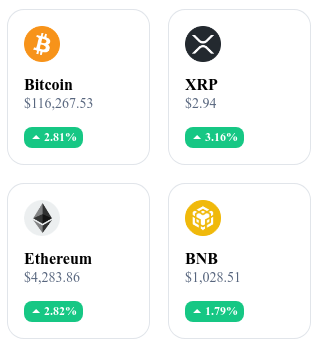

24h crypto recap! ⏱
🖼️ Base dominates the NFT market with 1.27M transactions
The Base blockchain recorded 1.27 million NFT transactions in one month, taking the top spot in the market. This activity generated more than $19M in volume, surpassing Ethereum and Solana.
👉 Read the full article
🇺🇸 Massachusetts: proposal for a Bitcoin reserve to cover state funds
Lawmakers in Massachusetts have introduced a proposal to create a strategic Bitcoin reserve to secure part of public funds. The text suggests allocating 5% of budget surpluses to regular BTC purchases.
👉 Read the full article
🇫🇷 Strasbourg wants to create its own municipal cryptocurrency
The municipality of Strasbourg has announced a local cryptocurrency project intended for municipal service payments and the circular economy. The city council is expected to vote on the measure by the end of the year.
👉 Read the full article
💰 Tether could become the most profitable crypto company
A financial report estimates that Tether could generate more than $12B in annual profits. This projection is based on revenues from U.S. Treasury reserves.
👉 Read the full article

📌 Crypto of the Day: Plasma (XPL)
Innovation and Added Value 🧠
Plasma is a layer-1 blockchain specifically designed for stablecoin payments and decentralized financial services. Its architecture combines EVM compatibility, optimized execution in Rust via Reth, and a PlasmaBFT consensus derived from HotStuff, ensuring both speed and security.
The project stands out with its Plasma One application, an integrated neobank that allows users to manage digital dollars, save, pay, and transfer USD₮ with no fees. Plasma aims to make crypto payments as seamless as traditional banking apps, while maintaining the transparency and efficiency of Web3.
The Token 💰
The XPL token is at the core of the ecosystem. It is used to pay gas fees, secure the network through staking, and reward validators. A portion of the fees is burned, introducing a deflationary mechanism. Users can also generate revenue by depositing stablecoins into vaults that yield XPL.
At launch, 1.8 billion tokens were in circulation out of a planned total supply of 10 billion, with a vesting schedule designed to regulate distribution. This model combines practical utility, economic incentives, and long-term sustainability.
Real-Time Performance 📊
💵 Current Price: 1.23 USD
📈 24h Change: +2.84%
💰 Market Cap: 2,214,000,000 USD
🏅 Rank on CoinMarketCap: #59
🪙 Circulating Supply: 1,800,000,000 XPL
📊 Trading Volume (24h): 2,045,000,000 USD

Bitcoin: A historic year-end?
As 2025 draws to a close, Bitcoin finds itself at the center of legislative, economic, and geopolitical dynamics that could redefine its role in the global financial system. From promising bills in the United States to the evolution of the ETF market, the digital asset appears to be entering a new phase of institutional maturity.
A more favorable U.S. legislative framework
The U.S. regulatory landscape is currently shifting in a way that could open a new chapter for Bitcoin. Two separate legislative initiatives embody this push for legal structuring: the CLARITY Act and the Bitcoin Act.
The CLARITY Act envisions placing Bitcoin under the supervision of the Commodity Futures Trading Commission (CFTC). This authority, historically more flexible than the Securities and Exchange Commission (SEC), would be tasked with regulating the asset, thereby facilitating institutional market access. Such an approach could remove regulatory barriers and accelerate Bitcoin’s adoption in bank portfolios or pension funds.
The second bill, the Bitcoin Act, was introduced by Senator Cynthia Lummis. Its ambition goes beyond regulation: it proposes the creation of a strategic Bitcoin reserve. The plan is to purchase one million BTC over five years, at a rate of 200,000 units per year. This initiative aims to anticipate a potential weakening of the U.S. dollar and position Bitcoin as a strategic hedge for national financial stability.
Institutional flows accelerate market maturity
Alongside legislative efforts, capital flows reflect a broader shift. Since January 2024, Bitcoin ETFs have absorbed nearly $60 billion. Among them, BlackRock’s IBIT dominates volumes. Long absent from the crypto market, Vanguard has finally reversed its stance and now offers its clients access to these products, signaling a major strategic shift for one of the giants of asset management.
This surge in ETFs represents a form of institutional validation. It allows so-called “traditional” investors to gain exposure to Bitcoin within a regulated framework, without relying on legacy crypto exchanges.
On the macroeconomic front, another factor could act as a catalyst: the return of quantitative easing (QE). In a context of monetary easing anticipated by markets, some analysts foresee a new phase of money creation, potentially benefiting assets perceived as alternative stores of value.
Finally, on a global scale, a report by Deutsche Bank projects that by 2030 Bitcoin could coexist with gold in central bank reserves. While speculative, this scenario reflects a growing trend to view digital assets as components of the future international monetary balance.
