



Hello Cointribe! 🚀
Yo, crypto fam! 🚀 It’s Tuesday, February 24, 2026—and as the markets never pause, here’s what’s been happening across crypto in the last 24 hours!
But first…
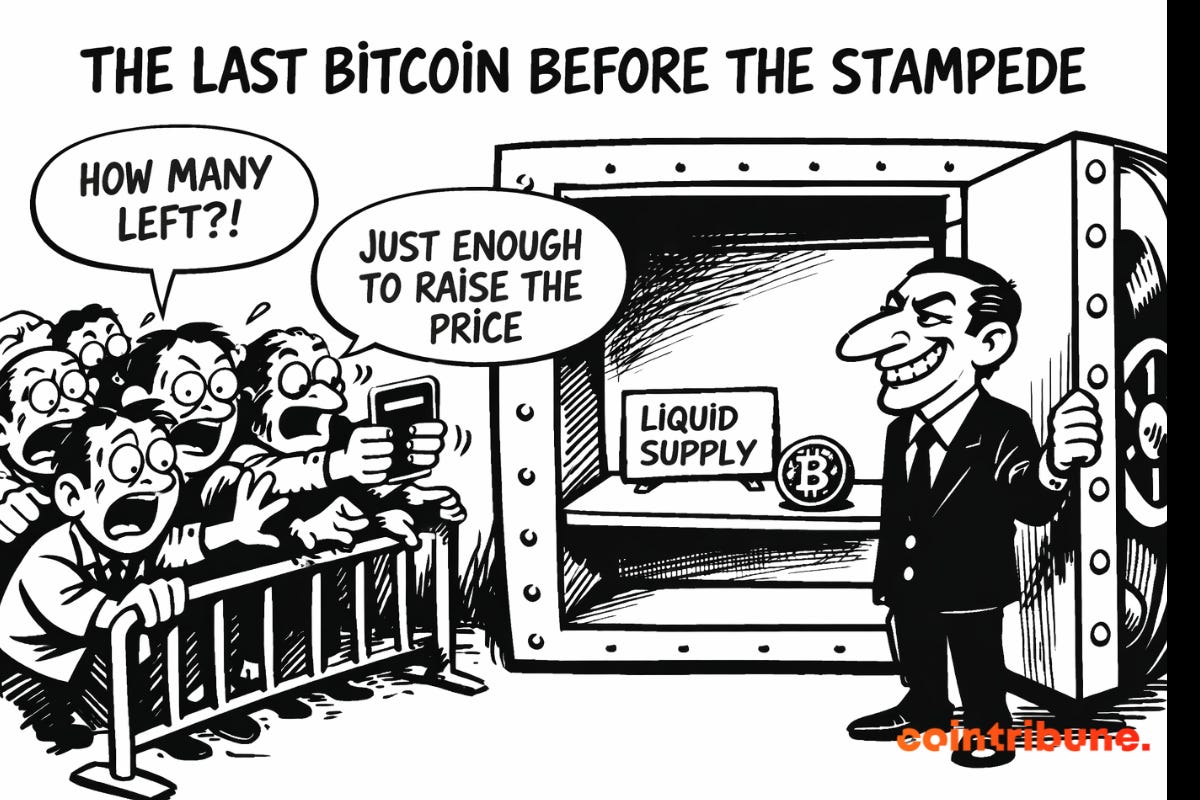
✍️ Cartoon of the day:
A quick look at the market…
🌡 Weather:
🌩️ Stormy
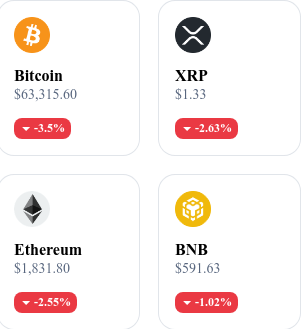

24h crypto recap! ⏱
📈 Strategy Moves Toward 750,000 BTC
Strategy currently holds 717,131 BTC after acquiring 2,486 BTC for approximately $168 million. CEO Michael Saylor indicated that additional purchases could occur, with the long-term goal of reaching 750,000 BTC. The company continues its accumulation despite a prolonged bear market, a context described as a “crypto winter.” Its holdings now represent over 3 % of total circulating Bitcoin. The strategy reflects an ongoing institutional approach to Bitcoin treasury management and accumulation.
👉 Read the article
💸 Crypto Capital Diverts from Tokens to Stocks
Most tokens launched in 2025 are now below their introduction price, with 84.7 % trading lower and half losing more than 70 % of their value. Projects valued over $1 billion show a median loss of 81 %. Meanwhile, crypto IPOs raised $14.6 billion, 48 times the amount in 2024, and mergers and acquisitions reached $42.5 billion, a five-year record. Investor capital is shifting from underperforming crypto tokens into stocks, reflecting a change in allocation preferences.
👉 Read the article
🤖 Vitalik Buterin Challenges AI “Web 4.0” Sovereignty Claims
Ethereum co-founder Vitalik Buterin has criticized claims by Sigil Wen that a new AI, “The Automaton,” can operate independently without human involvement. Wen describes it as self-replicating and self-improving, forming the basis of “Web 4.0.” Buterin highlights that centralized infrastructure undermines claims of AI sovereignty. He also points to recent $1.78 million Moonwell exploit risks and emphasizes that human oversight remains essential for smart contract and AI operations.
👉 Read the article
📊 Bitcoin Has 88 % Chance to End the Year Higher
Economist Timothy Peterson estimates an 88 % probability that Bitcoin will finish the year above its current $68,000 price. Over the past 24 months, exactly 50 % of months have recorded positive returns. Bitcoin is currently about 25 % below its early 2025 level. Analysts remain divided, with some expecting a near-term rebound and others projecting a market bottom around October 2026. The data is based on historical month-to-month performance metrics.
👉 Read the article
✅ Kraken Views Compliance as a Competitive Advantage
Dorian Vincileoni, Kraken’s France general manager, explains that regulatory compliance strengthens the exchange’s market position. Kraken integrates compliance into its operations, viewing it as a strategic asset rather than a constraint. The platform supports client verification processes and adheres to anti-money-laundering and securities regulations. Vincileoni emphasizes that complying with local laws allows Kraken to operate securely across multiple regions while maintaining service quality and building trust with institutional and retail users.
👉 Read the article

🐸 Crypto of the Day: Pepe (PEPE)
PEPE is currently trading around $0.000004024, and the structural shift is clearly visible on the 4-hour chart. A pattern that had been shaping as a descending triangle—typically a bearish continuation setup—has instead resolved upward. Rather than breaking beneath support, price pierced the descending trendline, signalling that sellers have lost short-term control.
The horizontal base near $0.00000409 previously acted as firm demand. That defense laid the foundation for the breakout. Once descending resistance gave way, price began forming higher lows, marking an early transition from distribution to accumulation on the lower timeframe.
Key structural developments (4H):
The descending resistance trendline has been breached
Demand confirmed around $0.00000409
Higher lows forming post-breakout
Short-term bias turning constructive
Daily Indicators Signal Stabilisation
While the breakout appears on the 4-hour chart, momentum indicators from the 24-hour timeframe provide broader context. Bollinger Bands on the daily chart had tightened during consolidation and are now beginning to show early expansion, hinting that volatility may be returning.
Price is hovering near the daily mid-band (20-day moving average), suggesting a battle for directional control. Meanwhile, the Relative Strength Index (RSI) on the daily timeframe is attempting to stabilize near the neutral 50 zone. A sustained push above 50 would strengthen the bullish case, whereas rejection could delay continuation.
Resistance Defines the Next Move
After reaching $0.00000422, PEPE retraced toward current levels in what appears to be measured consolidation rather than aggressive selling.
The next resistance area remains between $0.00000430 and $0.00000450. Holding above the reclaimed 4-hour trendline support keeps the bullish continuation scenario viable, but confirmation from daily momentum indicators will be key for sustained upside.
📊 Real-time Performance (CMC)
💵 Current Price: $0.000004024
📉 24h Change: -0.85%
💰 Market Capitalization: $1.66B
🏅 CoinMarketCap Rank: #40
🪙 Circulating Supply: 413.77T PEPE
📊 Trading Volume (24h): $329.56M

🚀 Bitcoin Demand Turns Positive as Liquid Supply Tightens
Bitcoin’s market structure appears to be shifting. Recent on-chain data suggests that liquid supply—the amount of Bitcoin readily available for trading—is tightening, while demand indicators are beginning to improve. Rather than a surge driven purely by price speculation, this change comes from supply dynamics that historically precede stronger market behavior.
A tightening of liquid supply occurs when coins are moved off exchanges into long-term storage or when large holders refrain from selling. As a result, less Bitcoin is available to meet active buy orders, which can reduce selling pressure and support prices when demand returns. At the same time, demand metrics—including net flows into exchange products and accumulation by key holder cohorts—are beginning to signal renewed interest after a period of stagnation.
📊 Key Signals Behind the Shift
Falling exchange balances: Bitcoin held on exchanges continues to decrease, indicating that holders are not ready to sell and are pulling liquidity away from trading platforms.
Demand turning positive: Net demand indicators, such as weekly accumulation rates, have shifted upward, suggesting buying interest may be creeping back into the market.
Long-term holding increases: More Bitcoin is being held by long-duration wallets, reducing the amount available for quick trading or short-term selling.
Liquid supply tightening: The combination of off-exchange flows and reduced selling pressure is shrinking the pool of coins that could quickly enter the market.
Together, these signals point to an environment where supply constraints could begin to outweigh downward pressure, creating conditions favorable for price support if demand continues to strengthen.
🔍 What This Could Imply
A tightening of liquid supply does not guarantee a breakout, but it does change the market’s internal balance. When fewer coins are available to sell and more are being removed from active pools, even modest buying pressure can have a larger price impact. In past cycles, similar patterns have preceded periods of renewed momentum once demand sustainably increases.
This shift also suggests a psychological change among holders: rather than reacting to short-term volatility, many participants may be viewing recent price levels as accumulation opportunities. That mindset can slow down selling pressure and support more stable market behavior over time.
🧠 Mix of Caution and Optimism
While demand signals turning positive is encouraging, it’s important to distinguish this from explosive growth expectations. The recovery appears to be measured, not dramatic—with demand rising gradually and supply tightening over time. Traders and investors should watch whether demand indicators continue to strengthen and whether the shrinking liquid supply begins to translate into price support.
