



Hello Cointribe! 🚀
Today is Thursday, October 16, 2025, and as every day from Tuesday to Saturday, we bring you the top crypto news from the past 24 hours you shouldn’t miss!
But first…
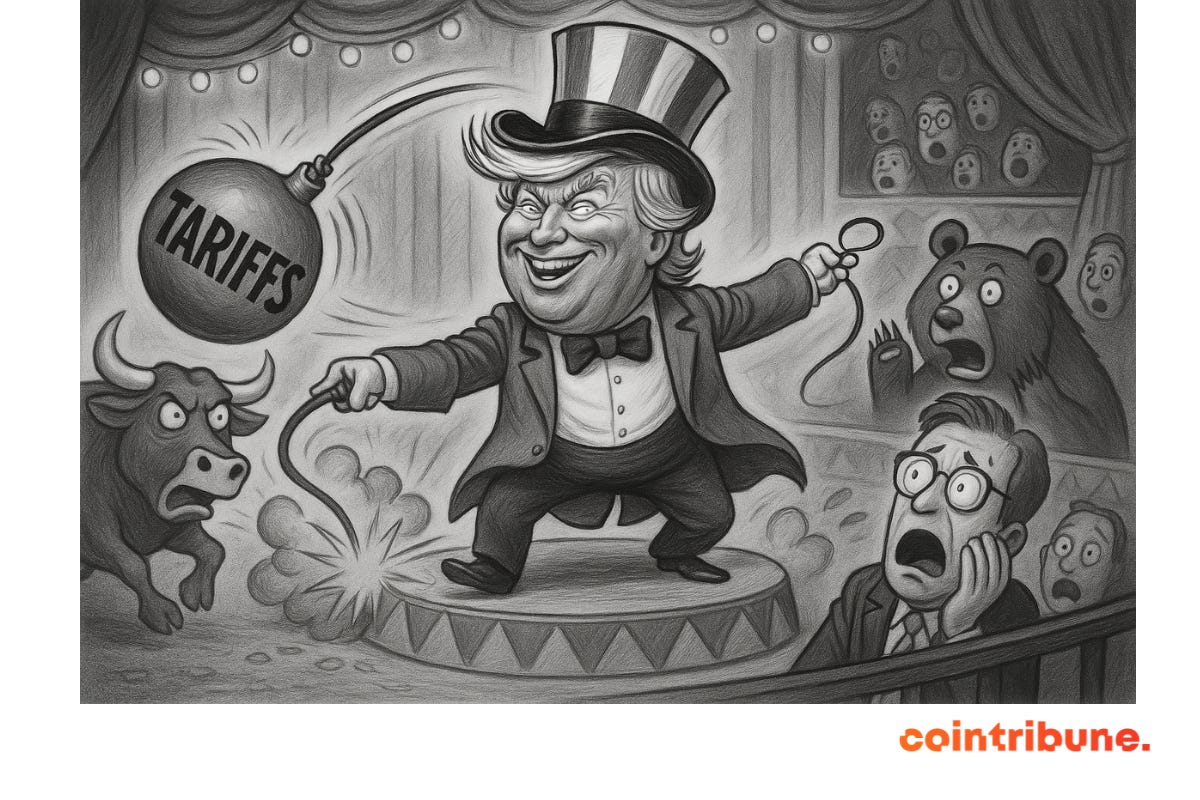
✍️ Cartoon of the day:
A quick look at the market…
🌡 Weather:
🌧️ Stormy
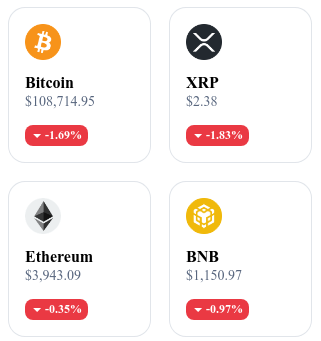

24h crypto recap! ⏱
⚔️ Trade war: Trump unveils a plan that shakes the markets
Donald Trump has presented an economic policy plan introducing heavy tariffs on Chinese imports, causing an immediate downturn in global stock markets. Investors fear an escalation in trade tensions between the United States and China, with direct consequences for investment flows and international trade.
👉 Read the full article
🪙 Coinbase to list Binance’s BNB after years of exclusion
Coinbase has confirmed the listing of BNB, Binance’s native token, after more than four years of exclusion due to compliance concerns. This decision marks a turning point in the U.S. exchange’s policy and signals the gradual integration of major tokens into regulated American platforms.
👉 Read the full article
🎨 NFT market attempts a rebound after $12B in losses
The NFT sector is seeing renewed activity after losing over $12 billion since its 2022 peak. Sales volumes rose 38% in Q3, driven by the comeback of major collections like BAYC and DeGods.
👉 Read the full article
💵 Stablecoin market hits $156 trillion in transfers and $300B in supply
The stablecoin market processed over $156 trillion in transfers during Q3 2025, according to Visa data. Total supply exceeded $300 billion, fueled by growth in USDT, USDC, and DAI, confirming their dominance in digital payments and decentralized finance.
👉 Read the full article

Crypto of the Day: Axelar (AXL)
Innovation and Added Value 🧠
Axelar is a cross-chain interoperability infrastructure connecting more than 50 blockchains, enabling decentralized applications (dApps) to communicate with each other seamlessly and securely. The network provides a universal layer that facilitates asset transfers, smart contract calls, and data sharing across distinct ecosystems (Ethereum, Cosmos, Avalanche, Polygon, etc.).
Unlike traditional bridges, Axelar relies on a decentralized validation model based on consensus, ensuring secure cross-chain transactions. The protocol also provides a developer kit (SDK) and simple APIs, making it possible to create truly interoperable applications. Axelar plays a strategic role in building a unified Web3, where blockchains no longer operate in isolation.
The Token 💰
AXL is the native token of the Axelar network. It is used to pay inter-chain transfer fees, secure the network through staking, and participate in governance. Validators lock their AXL to validate transactions, while delegators can stake their tokens to earn a share of rewards.
The economic model is designed to support network sustainability: part of the fees is redistributed, and holders play a key role in protocol evolution decisions. By supporting blockchain connectivity, the AXL token becomes a core asset of interoperable Web3.
Real-Time Performance 📊
💵 Current Price: 0.682 USD
📉 24-Hour Change: −0.84 %
💰 Market Cap: 498,400,000 USD
🏅 Rank on CoinMarketCap: #131
🪙 Circulating Supply: 730,300,000 AXL
📊 24-Hour Trading Volume: 7,210,000 USD

Bitcoin plunges to $107,000!
Once again, the cryptocurrency market has witnessed a sharp and sudden event. Bitcoin’s price dropped to $107,000, triggering more than $714 million in liquidations across derivatives exchanges.
Massive liquidations and a critical threshold: the mechanics of a sudden crash
After briefly hitting $107,625, Bitcoin activated a cascade of liquidations — mostly long positions using leverage. These liquidations totaled $714 million, making it one of the largest forced market resets in months. In a market increasingly dominated by derivatives, “liquidation zones” now play a critical role. When large clusters of leveraged positions are concentrated around specific price levels, those levels become natural targets.
This “liquidation hunting” phenomenon is often intensified by high-frequency trading algorithms, which detect these vulnerable levels and push prices toward them to trigger forced selling. The $107,000 threshold likely acted as a liquidity magnet, exposing a concentration of stop-losses and margin calls at that point. The move lasted only a few minutes, but its intensity was enough to shake both spot and derivatives markets.
Leverage, market psychology, and implications for crypto derivatives
This sudden drop once again highlights the systemic risks of leverage. As trading platforms offer ever-higher leverage ratios, a growing share of market liquidity is tied to tight margins — making the ecosystem hypersensitive to even small price moves. This is not a new phenomenon, but its impact has been amplified by the increasing popularity of perpetual futures and other leveraged instruments.
Psychologically, such shocks create self-reinforcing volatility: the more traders fear sudden crashes, the more defensive their positioning becomes — reducing liquidity and further destabilizing prices. Erratic swings thus become the norm, complicating any medium-term technical outlook.
Regulators are watching these developments closely. The repetition of such large-scale liquidation events could accelerate calls for stricter oversight of crypto derivatives, especially on unregulated exchanges.
