



Hello Cointribe! 🚀
Stay in the loop this Thursday, January 15, 2026, with the key stories from the last 24 hours.
But first…
✍️ Cartoon of the day:

A quick look at the market…
🌡 Weather:
☀️ Sunny
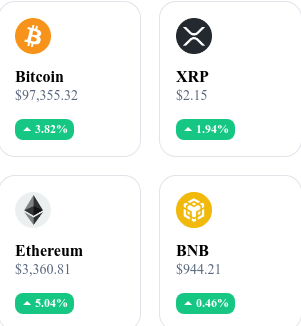

24h crypto recap! ⏱
⚠️ France Issues Warnings to 90 Crypto Firms Ahead of MiCA Deadline
French regulators have issued formal warnings to around 90 crypto-related entities as the deadline for compliance with the EU’s MiCA framework approaches. Authorities stress that firms operating without proper authorization risk sanctions or forced exit from the market. The move highlights France’s intention to enforce the new regulatory regime strictly, signaling a shift toward tighter oversight of crypto activities across the country.
🏦 Franklin Templeton Adapts Money Market Funds for Tokenization
Franklin Templeton has updated its money market fund structure to better integrate tokenized finance and stablecoin usage. The initiative reflects growing interest from traditional asset managers in blockchain-based settlement and on-chain liquidity. By adjusting operational frameworks, the firm positions itself closer to emerging financial infrastructures without abandoning regulatory safeguards.
👉 Read the full article
🔷 Polygon Seeks Regulated Status as a Payment Platform in the U.S.
Polygon has announced ambitions to operate as a regulated payment platform in the United States. The move would place the blockchain network under closer regulatory oversight while enabling it to offer compliant payment services. This strategy reflects a broader trend of crypto infrastructures aligning with traditional financial rules to support mainstream adoption.
👉 Read the full article
💹 Has the Crypto Cycle Changed? Signs of a New Market Era
The traditional four-year crypto cycle is increasingly being questioned as market structure, regulation, and institutional participation evolve. Analysts point to shifting liquidity patterns, macroeconomic pressures, and regulatory clarity as factors reshaping price behavior. Rather than repeating past cycles, the market may be entering a phase defined by new rules and different risk dynamics.
👉 Read the full article
📈 VanEck Sees Q1 2026 as a Turning Point for Risk Assets
Asset manager VanEck suggests that the first quarter of 2026 could mark a decisive shift for risk assets as greater policy clarity begins to emerge. According to the firm, easing uncertainty around monetary policy, regulation, and macroeconomic conditions may help restore investor confidence after a prolonged period of hesitation. While volatility is expected to persist in the short term, VanEck outlines how changing policy signals could reshape capital flows across equities, crypto, and other risk-sensitive markets.

Crypto of the Day: Bitcoin (BTC)
🧠 Bitcoin Approaches Key Resistance as Momentum Builds
Bitcoin is showing renewed strength as the price continues to stabilize above its recent base and push higher within a rising structure. Higher lows have formed, signaling that buyers are gradually tightening their grip on the market. This improvement in structure suggests that selling pressure has eased, allowing price action to turn more constructive in the near term.
Momentum indicators reinforce this shift. The RSI has moved back above the 50 mark and is holding in the mid-to-high 50s, a range that typically reflects bullish control without indicating overbought conditions. At the same time, Bitcoin has travelled from the lower Bollinger Band toward the upper band. The bands are beginning to expand, pointing to a return of volatility and hinting that the market may be preparing for a larger directional move rather than remaining range-bound.
Resistance Test and Growing Institutional Demand
Price is now pressing into a critical resistance zone around 96,000–97,000. This area represents a near-term decision point. A sustained daily close above it would strengthen the bullish outlook and open the door to a psychological retest of 100,000, followed by potential continuation toward the 103,000–105,000 region. Such a breakout would confirm that the recent consolidation is transitioning into a broader recovery phase.
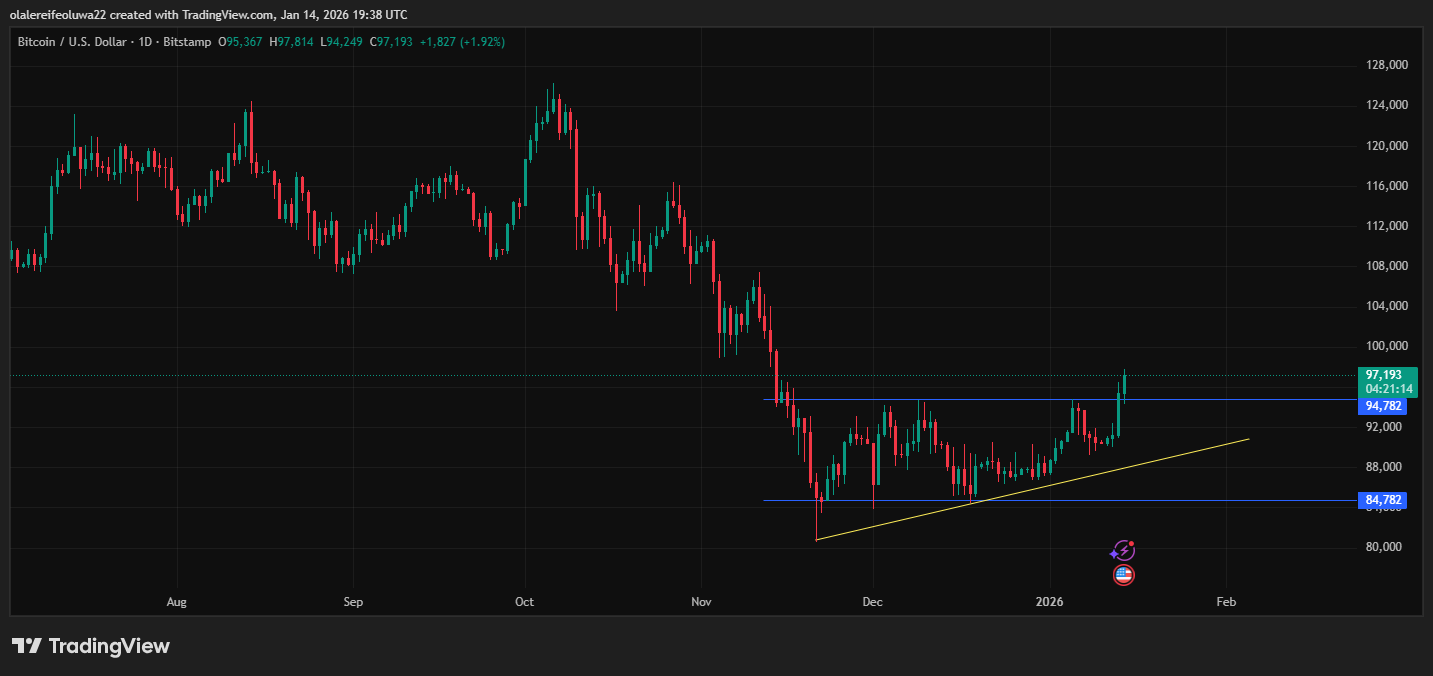
If Bitcoin fails to clear this resistance, a short-term pullback would remain technically healthy. As long as price holds above the rising trendline and the 94,000–95,000 area, the current structure stays intact. Only a decisive move below 90,000 would meaningfully weaken the setup.
Alongside the technical improvement, demand from institutional investors also picked up sharply. Spot Bitcoin ETFs recorded a combined net inflow of $843.62 million in a single session, the strongest daily addition seen so far in 2026, signaling that large investors are stepping back in as Bitcoin trades near a critical resistance zone.
📊 Real-Time Performance (CMC)
💵 Current price: $97,013.70
📉 24h change: 2.07%
💰 Market cap: $1.93T
🏅 CoinMarketCap rank: #1
🪙 Circulating supply: 19.97M BTC
📊 24h trading volume: $60.22B

🛡️ Crypto Security in 2025: Hacks Expose System Flaws and Push for Better Protection
A series of high-profile security incidents involving Trust Wallet and Ledger has once again put crypto asset protection under the spotlight, raising questions about how safe users really are as adoption expands.
😨 Major Security Breaches Shake Confidence
A compromised Trust Wallet browser extension enabled attackers to drain millions by intercepting users’ recovery phrases, while a separate data leak linked to Ledger’s e-commerce partner exposed personal customer information. Although hardware wallets themselves were not breached, the incidents reinforced concerns around indirect attack vectors that target users rather than protocols.
🏛️ Centralisation Remains a Weak Spot
Both cases highlight how centralized components—such as third-party service providers, extensions, or APIs—can become single points of failure. Even widely trusted brands are not immune when parts of their infrastructure rely on external systems that attackers can exploit.
🔐 Limits of Traditional Security Measures
Audits, certifications, and standard compliance checks still play a role in protecting crypto platforms, but they are often static and reactive. These tools may fail to detect evolving threats, especially those that arise outside smart contracts, such as compromised updates or leaked user databases.
👀 New Security Models Gain Attention
Emerging decentralized security frameworks are being explored as alternatives. Solutions based on zero-trust architecture and continuous device verification aim to reduce reliance on central authorities and improve real-time threat detection while also preparing for future risks like post-quantum attacks.
🔎 A Turning Point for User Protection
As attackers increasingly target users and infrastructure rather than blockchains themselves, the latest breaches suggest that securing crypto assets will depend less on brand trust alone and more on adaptive, decentralized security systems designed to minimize exposure at every layer.
