



Hello Cointribe! 🚀
Hey crypto crew! 🚀 It’s Friday, February 27, 2026, and the market’s been anything but quiet. The charts have been dancing, the headlines have been flying, and the crypto streets are buzzing. If you blinked, you probably missed a move. Here’s your sharp, no-fluff rundown of everything that’s gone down in the past 24 hours. Let’s get into it.
But first…
✍️ Cartoon of the day:
A quick look at the market…
🌡 Weather:
⛈️ Stormy

24h crypto recap! ⏱
🐕 Shiba Inu Range Narrows as Open Interest Declines
Shiba Inu is trading within a tightening price range while derivatives open interest continues to decline. Futures data shows reduced positioning activity alongside lower volatility. The contraction follows recent price fluctuations and reflects decreasing leverage exposure in the market. Trading volumes have moderated as the asset consolidates within defined technical levels. The combination of narrowing range and falling open interest highlights a cooling phase in SHIB’s short-term derivatives activity.
👉 Read the article
₿ 21Shares Lists STRC Offering Bitcoin-Backed Yield in Europe
21Shares has listed STRC, a structured product designed to provide yield backed by Bitcoin exposure in Europe. The instrument combines digital asset allocation with income-generation mechanisms. It is structured to comply with European regulatory frameworks and targets investors seeking BTC-linked returns with yield characteristics. The listing expands the range of exchange-traded crypto products available in the region.
👉 Read the article
🐋 Cardano Whales Accumulate 819 Million ADA During Market Weakness
Large holders accumulated approximately 819 million ADA amid broader market weakness. On-chain data shows increased wallet balances among major addresses while price performance remained subdued. The accumulation occurred during a period of declining momentum across several crypto assets. Whale activity has influenced overall supply distribution within the Cardano network during the consolidation phase.
👉 Read the article
⏳ Bitcoin Confronts $10.5 Billion Options Expiry
Bitcoin is approaching a $10.5 billion options expiry event. The expiration includes both call and put contracts across major derivatives platforms. Open interest concentration near key strike prices could influence short-term volatility. Traders are monitoring positioning distribution as the expiry date approaches. Such large-scale expirations typically represent significant liquidity moments within the derivatives market.
👉 Read the article
🏛️ Sovereign Adoption Expands as 23 Governments Hold Bitcoin
Twenty-three governments currently hold Bitcoin, reflecting expanding sovereign exposure to digital assets. National holdings originate from direct purchases, mining operations, and asset seizures. The accumulation places Bitcoin within certain state treasury strategies and reserve structures. The distribution of holdings varies by country, with some positions representing significant allocations. Government participation highlights Bitcoin’s presence within public-sector balance sheets alongside traditional financial assets.
👉 Read the article

🚀 Crypto of the Day: Mira (MIRA)
MIRA has recently caught the attention of traders after a sharp upward move, signaling a potential shift in market sentiment. After weeks of consolidation, the token broke above its short-term resistance, suggesting renewed interest and buying pressure. The candlestick shows a strong push upward, though a long upper wick indicates some profit-taking near higher levels.
Technical Indicators Show Bullish Momentum
Technical signals support the recent surge. The Bollinger Bands are widening, reflecting increased volatility after a period of calm. Price has moved above the middle band ($0.1034), which often acts as a pivot point, and is currently testing the upper band around $0.1058. Meanwhile, the RSI sits at 56.42, indicating positive momentum without being overbought, leaving room for potential further gains. Strong trading volume, which spiked to 120.6 million, confirms that buyers are driving this move rather than speculative noise.
Key Levels and Price Projection
Traders should keep an eye on critical support and resistance zones:
Support: $0.1034 (middle Bollinger Band), $0.0899 (recent consolidation low)
Resistance: $0.1058 (upper Bollinger Band), $0.12–$0.13 (psychological levels)
If MIRA sustains above the breakout zone, it could test $0.115–$0.12 in the short term, with the potential to reach $0.13–$0.14 if bullish momentum continues. On the flip side, a drop below $0.104 could trigger a retracement toward support levels.
Overall, MIRA’s recent surge demonstrates renewed market confidence. With technical indicators showing continued momentum and strong volume, the token appears primed for potential further gains in the near term.
📊 Real-time Performance (CMC)
💵 Current Price: $0.1026
📉 24h Change: 15.42%
💰 Market Capitalization: $25.13M
🏅 CoinMarketCap Rank: #585
🪙 Circulating Supply: 244.87M MIRA
📊 Trading Volume (24h): $127.64M

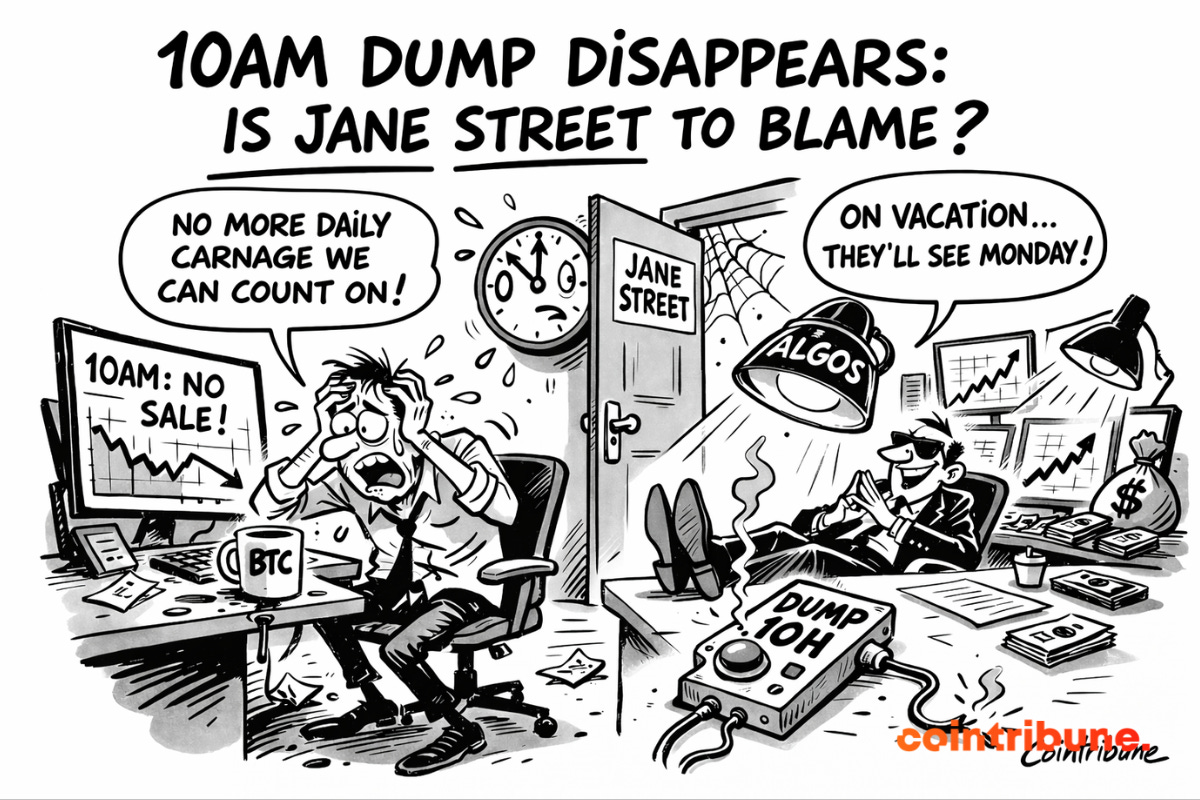
🕙 End of the 10 AM BTC Dump Fuels Suspicions Around Jane Street
Bitcoin’s price has historically displayed a repetitive dip around 10 AM UTC, a pattern that traders have dubbed the “10 AM dump.” For months, this anomaly appeared almost mechanically—a dip at the same hour that reset rallies and frustrated breakout attempts. Recently, however, that pattern stopped occurring, catching the attention of analysts and creating fresh debate about what was behind it.
Among the theories gaining traction is renewed suspicion around Jane Street, a major market-making firm active in crypto and traditional finance. Because Jane Street is known to execute large orders and has sophisticated arbitrage strategies, some traders believe that the firm’s activity may have contributed to the regular morning price declines. With the pattern now broken, these suspicions are being revisited and discussed more openly in trader communities and on-chain analysis circles.
📊 Key Points Behind the Shift
Repetitive 10 AM dumps disappeared: A recurring pattern tied to price declines at a specific hour has ended, breaking a trend that had persisted for weeks.
Trader suspicions resurfacing: Some market observers link the original pattern to large systematic players, with Jane Street frequently mentioned due to its scale and algorithmic strategies.
Correlation ≠ causation caution: Analysts note that while patterns can coincide with specific participants’ activity, they don’t prove intentional price manipulation.
Market structure evolving: As volatility shifts and trading desks adapt, formerly reliable intraday patterns can fade simply due to changing capital flows and operational adjustments.
This mix of technical change and speculative interpretation has captured trader attention precisely because the 10 AM dumps were so consistent—and their disappearance adds a new layer of mystery.
🔍 Why the Pattern Mattered
Patterns like the 10 AM move were not just curiosities; they shaped trader behavior. Many short-term participants planned around these intraday dips, using them to enter positions, reset profit targets, or manage risk. When a seemingly mechanical pattern disappears, it forces a reassessment of strategies and expectations.
For some, the assumption was always that the pattern was driven by institutional flows surfacing at specific times—perhaps related to liquidity windows, hedging activity, or cross-market arbitrage. Jane Street’s involvement became part of the conversation because it is one of the largest trading firms in crypto markets and often sits on the opposite side of retail or liquidity provider orders.
🧠 A Nuanced Take on Suspicions
While suspicions around Jane Street have risen, many analysts and commentators urge caution. Price patterns can reflect natural liquidity imbalances, coordinated hedge activity, or even retail order clustering—none of which necessarily imply malicious intent or intentional manipulation.
The end of the pattern may simply reflect evolving market participation: liquidity providers and algorithmic traders adjust strategies over time, especially in response to volatility regimes and shifting exchange behavior. As such, the disappearance of the 10 AM dump may be less about one firm and more about broader changes in order flow and market mechanics.
