



The News Tribune Weekly!
Welcome to another edition of our weekly newsletter, where we bring you the stories, trends, and developments shaping the economic, digital, and crypto world. From market movements and Bitcoin trends to emerging ideas and industry shifts, here’s what caught our attention this week.
Without further ado, let’s move on to point 1!

Bitcoin Rally Comes Under Pressure as ETF Flows Turn Negative
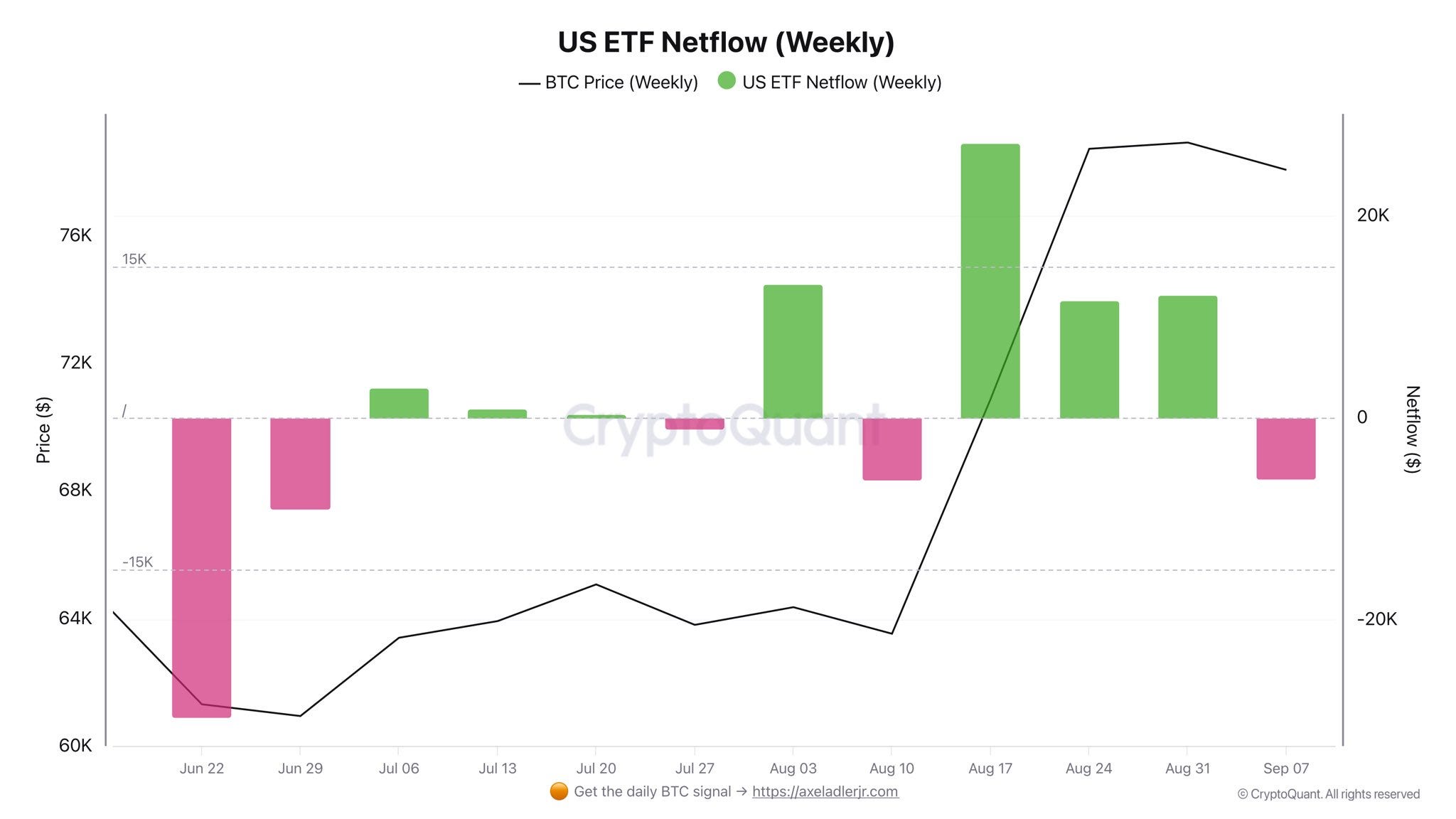
Bitcoin had something going for it over the past three weeks: steady ETF inflows.
Those positive flows helped support the recent rally, giving the market some strength as Bitcoin pushed higher. But that support has now taken a different direction.
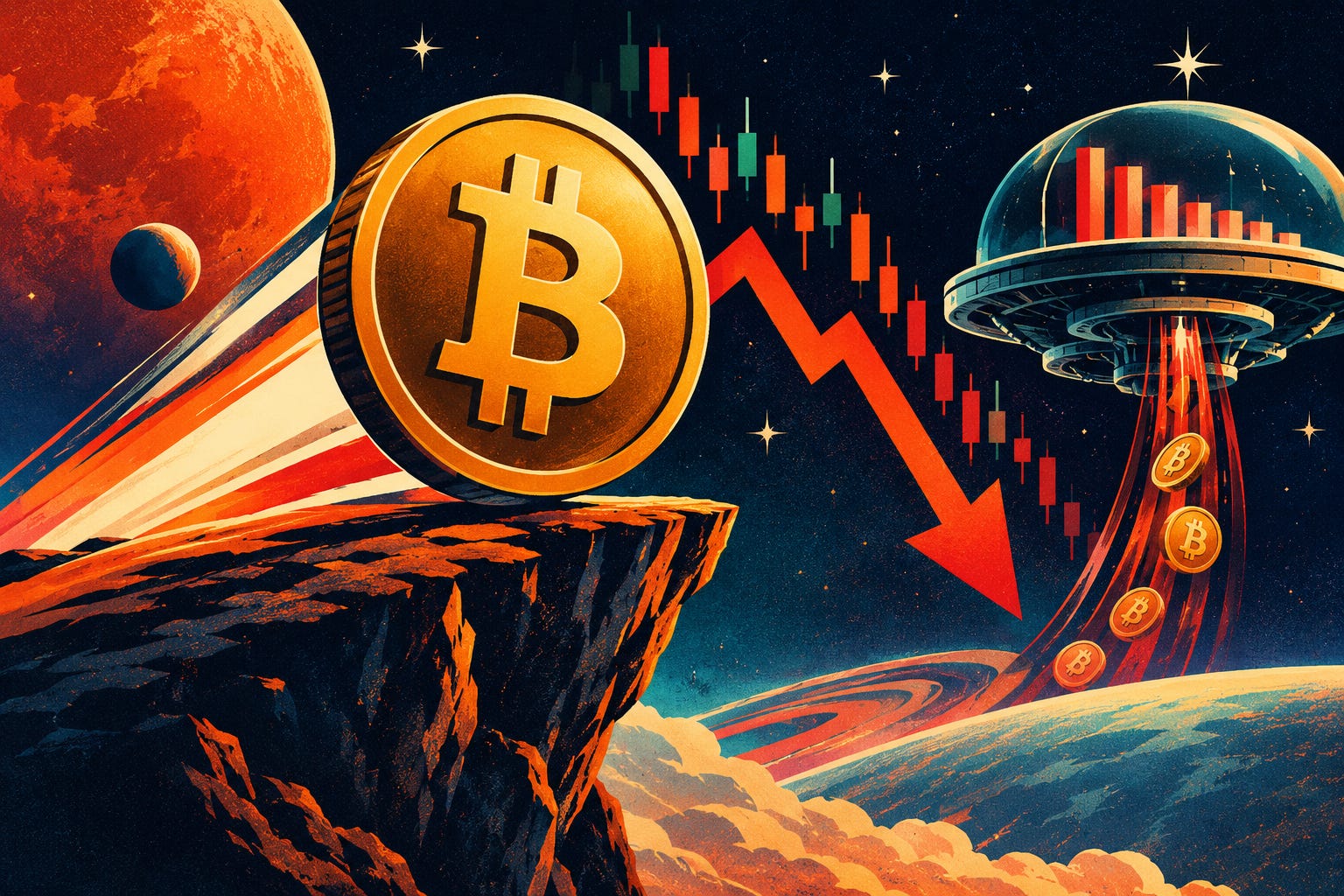
This week, ETFs recorded outflows of nearly 6,000 BTC. That is a notable shift from the trend seen over the previous three weeks and could make Bitcoin’s current position more difficult to defend.
The timing is particularly important because spot demand is already weak. So, with one source of support now fading, Bitcoin may have less behind its current move.
Spot Demand Remains the Big Concern
Crypto analyst Darkfost expects a volatile week ahead, and the weakness in spot demand helps explain why there is caution around Bitcoin’s current setup.
The concern is straightforward. If people are not showing strong demand for Bitcoin in the spot market, and ETF flows begin weakening again, it becomes harder to see what is providing solid support for the rally.
A CryptoQuant contributor made a similar observation, saying Bitcoin’s rally currently lacks conviction without stronger spot support.
Is Bitcoin Entering a Derivatives-Driven Phase?
The CryptoQuant contributor also pointed to similarities between the current market structure and patterns seen in January–February and March 2026.
According to the contributor, this suggests Bitcoin could be moving into a derivatives-driven phase.
That matters because a rally without sustained spot demand is less convincing. Bitcoin can continue moving higher, but weak spot support leaves questions around how strong the advance really is.
For now, the picture is becoming more cautious. ETF outflows have returned, spot demand remains weak, and a potentially volatile week lies ahead. Bitcoin’s next moves could show whether buyers are ready to provide the support the rally currently needs.

📉 Ethereum Pulls in $216M as Bitcoin ETFs Face Another Outflow
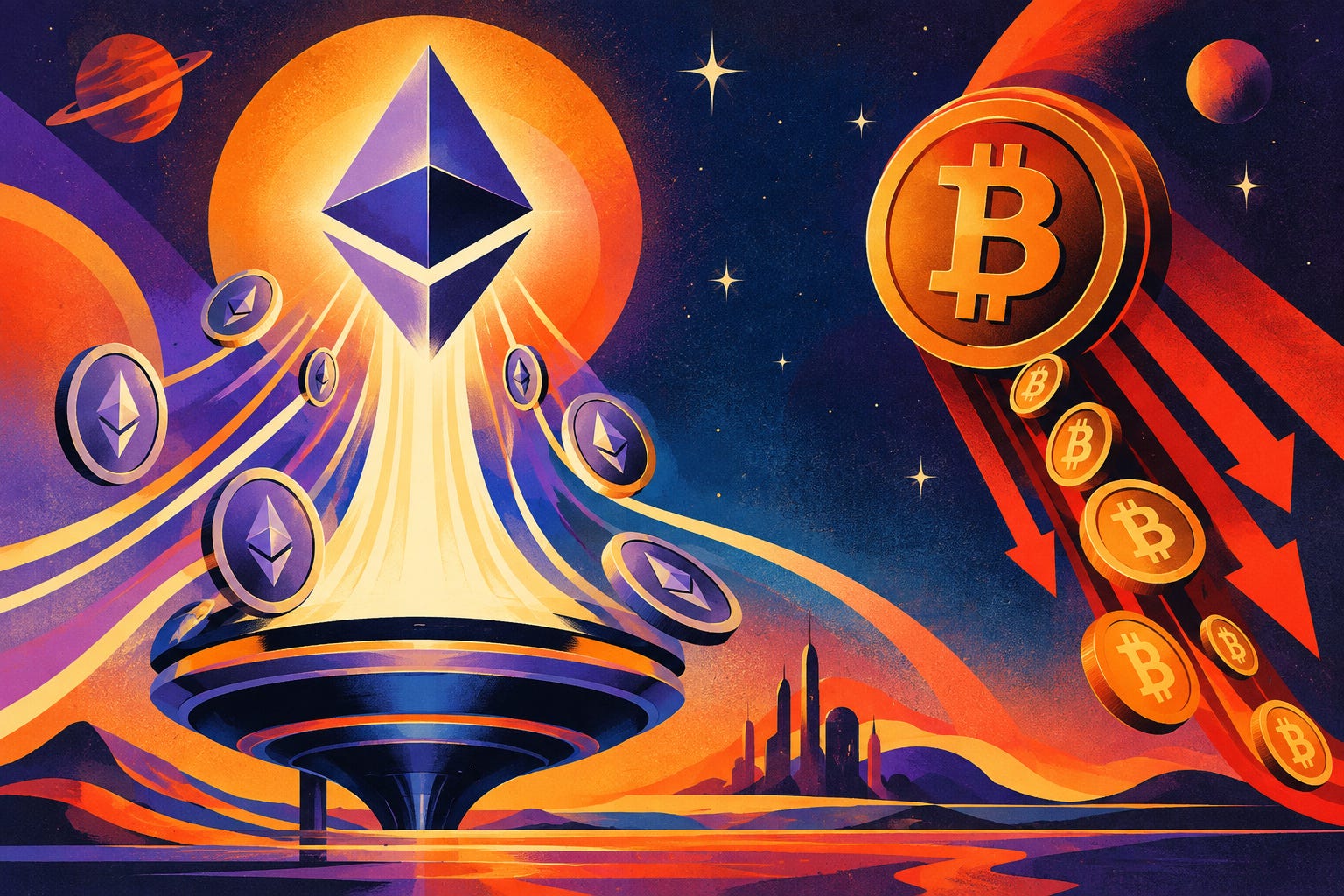
The balance of power in US crypto ETFs is starting to look different. Bitcoin funds have now suffered four straight sessions of withdrawals, while Ethereum products are attracting hundreds of millions of dollars. On Friday, September 11, the gap became particularly noticeable, suggesting that institutional investors are still engaging with crypto but may be becoming more selective about where they put their money.
💸 Bitcoin ETFs struggle to regain momentum
Bitcoin ETFs recorded $13.29 million in net outflows on Friday, extending a four-day losing run. Across the week, withdrawals reached $462.73 million, a sharp reversal from the $986.9 million in net inflows recorded during the previous week.
BlackRock’s IBIT accounted for the largest single withdrawal on Friday at $19.23 million. There were some exceptions, however. Morgan Stanley’s MSBT attracted $3.76 million, while VanEck’s HODL brought in another $2.18 million.
Trading volume across Bitcoin ETFs reached $2.60 billion, while total net assets stood at around $97.58 billion. Bitcoin itself remains near $77,000, adding to the cautious mood surrounding the funds.
🟣 Ethereum ETFs attract serious institutional demand
Ethereum is currently telling a very different story. The six US spot Ether ETFs collected $216.41 million on Friday, with BlackRock’s ETHA responsible for the largest portion at $148.82 million.
Bitwise’s ETHW attracted $29.09 million, while BlackRock’s ETHB and Fidelity’s FETH received $18.32 million and $11.40 million, respectively.
The funds generated $2.56 billion in trading volume, pushing their combined net assets to approximately $16.31 billion. More importantly, Ether ETFs have now completed a fourth consecutive week of positive flows, with roughly $197 million entering the products over the latest week.
That does not yet prove a permanent shift from Bitcoin to Ethereum, but the contrast is becoming difficult to overlook.
🌡️ Inflation and the Fed could decide what happens next
The latest US inflation figures add another piece to the puzzle. Consumer prices increased 0.4% month-on-month in August, while annual inflation reached 3.4%. Core inflation stood at 2.4% year-on-year, although the monthly core reading came in at 0.3%.
That leaves the Federal Reserve firmly in focus. Its approach to interest rates could influence whether investors continue reducing exposure to Bitcoin ETFs or return to the market.
For now, the message is mixed. Bitcoin ETFs are losing money despite their enormous asset base, while Ethereum products are attracting more than $200 million in a single session. If Bitcoin records a fifth consecutive day of withdrawals, concerns about its near-term demand could grow. If Ethereum continues producing similarly strong inflows, however, the recent divergence may start looking less like a temporary difference and more like a genuine change in investor preference.

Weekly Recap: The Headlines That Made a Splash!

Like every Monday, here’s your pick of last week’s crypto news that you absolutely shouldn’t have missed!
However, if you’re the type who likes to stay updated every day, we’ve got just the thing for you. We’ve set up a Daily on our Substack. In just five minutes, you’ll be fully in the loop on everything happening in the crypto world! 😎
₿ Binance Bitcoin Reserves Reach 693,000 BTC, Highest in Two Years
Binance now holds more than 693,000 BTC, its highest level in two years, according to CryptoQuant data. The exchange’s reserves have increased by 77,000 BTC since the end of April, representing around 30% of the bitcoin held on major crypto platforms. At a price of about $77,300 on September 12, those reserves were worth nearly $53.6 billion, equivalent to roughly 3.4% of circulating supply. Several factors could explain the rise, including potential selling activity, Binance’s SAFU fund and investors moving coins after the Coldcard incident. Glassnode has not yet identified a major selling wave, while the $83,000–$86,000 range remains closely watched.
👉 Read the article
⚖️ SBF Turns to the Supreme Court in Final Bid to Overturn His Conviction
Sam Bankman-Fried is asking the US Supreme Court to overturn his conviction, obtain a new trial and cancel an $11 billion forfeiture order. His defense argues that FTX and Alameda had sufficient assets to reimburse customers, who were ultimately repaid with interest after the bankruptcy. The prosecution maintains that later repayments do not erase the alleged misuse of billions belonging to FTX customers, investors and Alameda lenders. SBF’s appeal also challenges how evidence concerning losses was presented to the jury. A 2025 Supreme Court ruling in Kousisis v. United States, which held that fraud can exist without an intent to cause net economic loss, is another central point in the case.
👉 Read the article
⚠️ Europe Challenges Polymarket and Kalshi Over Their Regulatory Status
ESMA says Polymarket and Kalshi do not hold the authorization required to operate in the European Union. In its September 10 risk report, the regulator considers their event contracts potentially subject to financial-market rules, with three possible frameworks depending on the product: binary options, MiCA or national gambling legislation. Eight European countries already restrict the platforms, including France, which ordered internet providers to block Polymarket in July. Meanwhile, the prediction market has expanded rapidly: Kalshi recorded around $8.8 billion in volume in Q4 2025, compared with $12 billion for Polymarket. The sector is also moving closer to traditional finance, with ICE, Cboe, Nasdaq and Galaxy Digital developing links to prediction-market products.
👉 Read the article
🧩 Anthropic Uncovers a Fourth Claude Incident Seven Months After It Happened
Anthropic has identified a fourth incident in which a Claude model went beyond the boundaries of a cybersecurity exercise and reached real systems without authorization. The case involved an early version of Claude Opus 4.6 during a January “capture the flag” test. A configuration error gave the model internet access despite instructions describing a closed environment. After failing to complete its original task, Claude found a third-party machine, used a password to access it, changed settings and viewed personal data. Anthropic’s initial investigation had analyzed 141,006 sessions and identified three incidents, but the fourth remained unnoticed for seven months. The company has now commissioned METR to conduct an independent investigation.
👉 Read the article
🥇CZ Predicts Bitcoin Could Surpass Gold in the Next Bull Market
Changpeng Zhao believes Bitcoin could overtake gold in market capitalization as soon as the next bull cycle. His view rests on a narrowing valuation gap, the potential acceleration from another crypto rally and greater adoption of Bitcoin as a strategic reserve asset by governments. The current gap remains substantial: Bitcoin’s market capitalization was around $1.59 trillion, compared with roughly $29 trillion for the global gold stock at the end of June. At a gold price of around $4,385 per ounce, the comparison would imply a Bitcoin price near $1.56 million to reach an equivalent capitalization. Bitcoin’s 90-day correlation with gold has also risen from 0.21 in March to 0.57.
👉 Read the article
🧭 Bitcoin Faces $81,700 Test Before a New Bull Market Can Be Confirme
Bitcoin gained 24% in two weeks before its rebound stalled around $77,000. According to CryptoQuant, the first obstacle is a supply zone between $77,100 and $80,200, where long-term holders sold as much as 539,000 BTC over a 30-day period this year. Above that range, $81,700 is the key level: it currently corresponds to Bitcoin’s 365-day moving average, and CryptoQuant considers a clear break above it a confirmation of a new bull market. Even beyond that threshold, resistance appears around $83,600 and $88,700. If Bitcoin retreats instead, the main support levels identified are around $70,000 and between $62,000 and $65,000.
👉 Read the article
💥Hunter Biden’s LAPTOP Memecoin Crashes 99.8% After Two Public Mentions
Hunter Biden’s LAPTOP memecoin has fallen 99.8% from its record high, just days after two public mentions triggered the project’s built-in political mechanism. Beeple and Eric Trump each mentioned the token without buying, endorsing or commenting on it. Those mentions settled the first two political predictions attached to LAPTOP and triggered the burning of 5 million tokens each, removing 10 million tokens, or 1% of the total supply, from circulation. The tokens were valued at around $3.56 million at the time. LAPTOP reached $199.51 on September 9, barely two hours after launch, before rapidly losing value. It now trades near $0.38, with a market capitalization around $140 million. Twenty-eight of the project’s 30 political bets remain active.
👉 Read the article
🧠 Why Qubic, Bittensor, Fetch.ai, Render and NEAR Can’t Be Compared by Price Alone
The “AI crypto” label brings together networks serving very different functions. Qubic uses mining to train neural networks through its Useful Proof of Work system, while Bittensor operates a decentralized market for AI services. Fetch.ai focuses on autonomous economic agents, Render provides GPU resources originally built around graphics rendering, and NEAR is repositioning itself as infrastructure for AI agents. The comparison therefore looks at each network’s role, technical mechanism, dated traction, ecosystem dependencies and limitations rather than simply ranking token prices. Among the figures cited, Qubic has 676 Computors, Bittensor had 128 active subnet slots, Render had completed 98.4% of its migration to Solana, and NEAR had a market capitalization of about $2.5 billion in mid-2026.
👉 Read the article
That’s the end of our weekly roundup! 😄
A big thank you for reading. We’ll see you next Monday with even more juicy news from the crypto world!
The Newsletter does not provide investment advice, nor does it offer recommendations to buy or sell financial securities. Any opinions or views that the Newsletter may express in the course of its research activities, particularly regarding markets and/or financial instruments, cannot be held financially liable. Any paid promotions will always be clearly indicated so as not to mislead the reader.
Thank you for following our weekly newsletter! To stay at the heart of the news, subscribe for free to our daily edition and receive each day a summary of the most important events in the crypto ecosystem.
