



The News Tribune Weekly!
Great to have you here for another edition of our weekly newsletter, where we explore the most relevant and fast-moving topics shaping our economic and digital world.
Without further ado, let’s move on to point 1!

Chainlink Wallet Activity Picks Up Even as Price Lags Behind
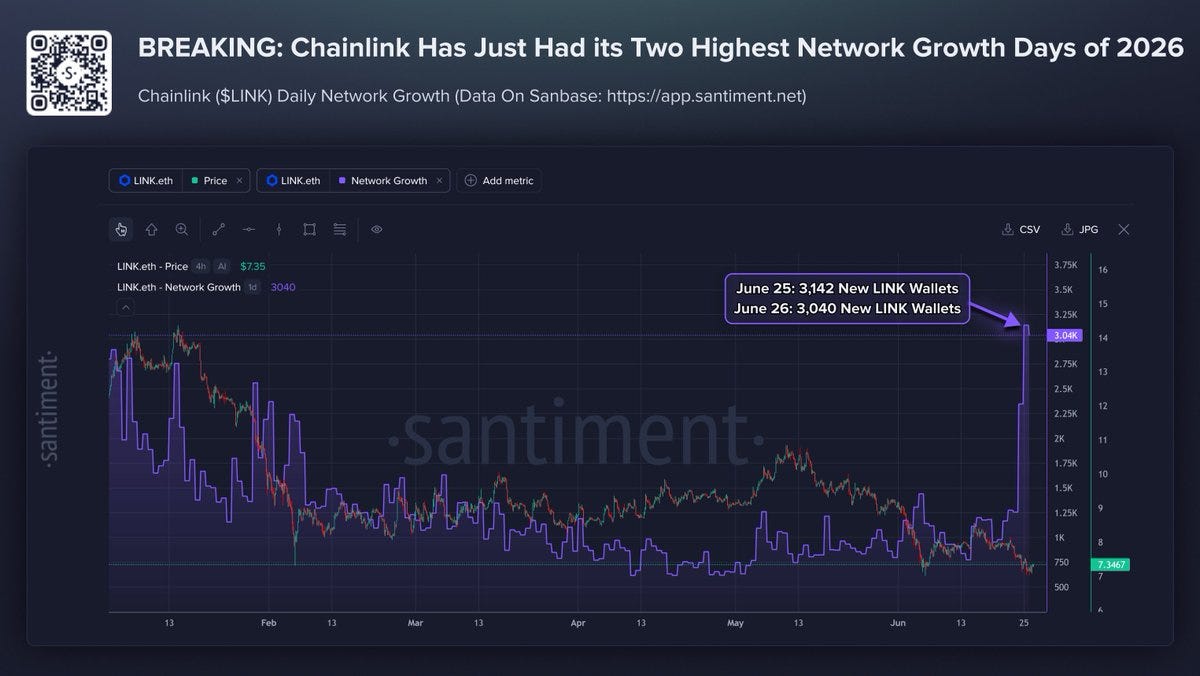
Chainlink has quietly recorded one of its strongest bursts of network growth in 2026 so far. On June 25 and 26, the network added more than 6,000 new wallets combined, with over 3,100 created on the first day and just over 3,000 the next. That kind of back-to-back increase usually doesn’t happen by accident. It often points to fresh users entering the ecosystem rather than short-term traders simply reshuffling funds.

What makes this more interesting is that it’s happening while market prices are still relatively weak. This suggests growing attention around Chainlink’s long-term use case, especially as it continues to position itself as a key layer in on-chain financial infrastructure.
Price action still stuck in a downtrend
While network activity is heating up, the price of LINK hasn’t followed the same path. The token is still hovering around the $7 region and remains stuck in a short-term downtrend. A clear descending trendline shows that every attempt to push higher has been met with selling pressure, forming a pattern that leans bearish in the near term.
Momentum indicators are also leaning cautious. The RSI is sitting in the low 30s, which shows that bearish pressure is still present, although it is edging closer to oversold levels. At the same time, trading volume has been slipping, which usually signals that the market is waiting for a stronger catalyst before making its next big move.
What the divergence could be signalling
This split between rising wallet activity and weak price action is where things get interesting. On one hand, price charts suggest hesitation and continued downside risk if support fails. On the other hand, growing user activity hints at quiet accumulation and increasing confidence in Chainlink’s broader role in tokenised markets and data infrastructure.
If momentum shifts, a break above the current trendline could open a path toward the $7.80 to $8.40 range. But if support around $7.04 gives way, another drop could follow.
For now, Chainlink is telling two different stories at once: short-term uncertainty in price, but longer-term growth building underneath.

📉 Strategy’s Bitcoin Model Is Under Real Pressure
Strategy’s long-running bitcoin accumulation approach is now facing its toughest test yet. The company still holds a massive 847,363 BTC, keeping it as the largest publicly listed corporate holder, but the recent drop in Bitcoin has put its position under strain.

With Bitcoin trading below the $60,000 level during this period, some of Strategy’s newer purchases are now sitting at a loss. Even so, Michael Saylor continues to signal ongoing accumulation, including a recent purchase of 520 BTC, showing that the buying strategy is still active despite weaker market conditions.
🔁 The mNAV drop is changing how the model works
A key turning point is the fall of Strategy’s mNAV below 1.0, down to around 0.80. This means the company’s stock is now trading below the value of the Bitcoin it holds.
That shift is important because the earlier accumulation model depended on the stock trading at a premium. When that was the case, issuing shares helped raise capital in a way that supported further Bitcoin purchases. With mNAV now below 1.0, that mechanism no longer works the same way.
To continue financing its Bitcoin strategy, the company has also relied on STRC preferred shares, but these instruments are now trading below their target value, adding further pressure on fundraising capacity.
📊 A tighter financing environment going forward
With both equity conditions and STRC preferred shares under pressure, Strategy’s ability to raise capital at favourable terms has weakened. That makes future Bitcoin purchases more expensive to fund and reduces flexibility in how aggressively the company can continue its accumulation plan.
This leaves Strategy in a more difficult position: continue buying Bitcoin despite higher financing costs or adjust its approach to protect the structure that supported its earlier growth phase.
The model hasn’t stopped—but the conditions that made it work smoothly are clearly under strain.

Weekly Recap: The Headlines That Made a Splash!

Like every Monday, here’s your pick of last week’s crypto news that you absolutely shouldn’t have missed!
However, if you’re the type who likes to stay updated every day, we’ve got just the thing for you. We’ve set up a Daily on our Substack. In just five minutes, you’ll be fully in the loop on everything happening in the crypto world! 😎
🇸🇻 El Salvador expands its Bitcoin treasury with a fresh purchase
El Salvador has added more Bitcoin to its national treasury, continuing its long-term accumulation strategy through a new acquisition. The purchase increases the country’s sovereign holdings as authorities maintain regular additions despite changing market conditions. The latest transaction follows previous treasury purchases and keeps Bitcoin at the centre of the country’s reserve policy. The move also highlights the government’s continued focus on integrating digital assets into its national financial strategy while monitoring portfolio growth over time.
👉 Read the article
💼 Bitwise reinforces its Hyperliquid strategy with a major HYPE investment
Bitwise has committed approximately 114 million dollars to Hyperliquid by transferring and staking 1.775 million HYPE tokens. The investment follows the launch of the firm’s BHYP exchange-traded fund, which combines exposure to the token with staking rewards. The operation increases Bitwise’s participation in the Hyperliquid ecosystem while expanding institutional access to the protocol through regulated investment products focused on digital assets.
👉 Read the article
🇪🇺 Most European crypto firms remain unlicensed days before MiCA deadline
Three days before the MiCA implementation deadline, around 80% of European crypto companies remain without the required authorization to operate under the new regulatory framework. The situation concerns licensing procedures, compliance requirements, and operational readiness across the sector. Companies continue working toward regulatory approval while European authorities prepare for the full application of the Markets in Crypto-Assets regulation.
👉 Read the article
📉 Brad Garlinghouse questions Strategy’s Bitcoin financing model
Ripple CEO Brad Garlinghouse has criticized Strategy’s debt-funded approach to acquiring Bitcoin, raising questions about the sustainability of financing large cryptocurrency purchases through leverage. The discussion compares different corporate treasury strategies used to gain Bitcoin exposure. It also examines capital allocation choices, balance sheet management, and the financial structures supporting long-term digital asset accumulation.
👉 Read the article
⚖️ Clarity Act faces tight Senate timeline before US midterm elections
The Clarity Act enters a crucial stage as the US Senate has limited time to consider the legislation before the upcoming midterm elections. The proposal seeks to establish a clearer regulatory framework for digital assets while defining the responsibilities of federal agencies overseeing the crypto industry. Lawmakers continue negotiations as legislative priorities compete for attention, leaving only a short period for debate, amendments, and a possible vote before the congressional calendar becomes increasingly constrained.
👉 Read the article
🔷 SharpLink expands Ethereum holdings after market decline
SharpLink acquired an additional 5,000 ETH as Ethereum traded near its lowest level of 2026. The purchase increases the company's digital asset holdings during a period of weaker market prices. Corporate treasury strategies involving Ethereum continue attracting attention as listed companies explore long-term exposure to blockchain assets. The latest acquisition adds to SharpLink's existing position while Ethereum remains under pressure across broader cryptocurrency markets.
👉 Read the article
🔮 Standard Chartered projects AAVE at $3,500
Standard Chartered forecasts that AAVE could reach 3,500 dollars as decentralized finance continues expanding across digital asset markets. The outlook follows growing activity within the Aave protocol, including lending, borrowing, and liquidity services used by institutional and retail participants. Market observers continue monitoring protocol adoption, revenue generation, and on-chain activity as decentralized finance platforms compete for a larger share of blockchain-based financial services.
👉 Read the article
🔓 DeFi records its highest number of crypto hacks since 2022
Decentralized finance has recorded 121 crypto hacks this year, resulting in billions of dollars in losses across multiple blockchain ecosystems. Attackers targeted smart contracts, cross-chain bridges, wallets, and decentralized applications through a variety of exploit techniques. Security incidents affected projects of different sizes, prompting developers and protocol operators to strengthen audits, monitoring tools, and vulnerability detection as threats continue affecting the broader DeFi ecosystem.
👉 Read the article
That’s the end of our weekly roundup! 😄
A big thank you for reading. We’ll see you next Monday with even more juicy news from the crypto world!
The Newsletter does not provide investment advice, nor does it offer recommendations to buy or sell financial securities. Any opinions or views that the Newsletter may express in the course of its research activities, particularly regarding markets and/or financial instruments, cannot be held financially liable. Any paid promotions will always be clearly indicated so as not to mislead the reader.
Thank you for following our weekly newsletter! To stay at the heart of the news, subscribe for free to our daily edition and receive each day a summary of the most important events in the crypto ecosystem.
