



The News Tribune Weekly!
Welcome to another edition of our weekly newsletter, where we bring you the stories, trends, and developments shaping the economic, digital, and crypto world. From market movements and Bitcoin trends to emerging ideas and industry shifts, here’s what caught our attention this week.

Without further ado, let’s move on to point 1!

Altcoin Rally Cools as Crypto Search Interest Falls to 2023 Lows
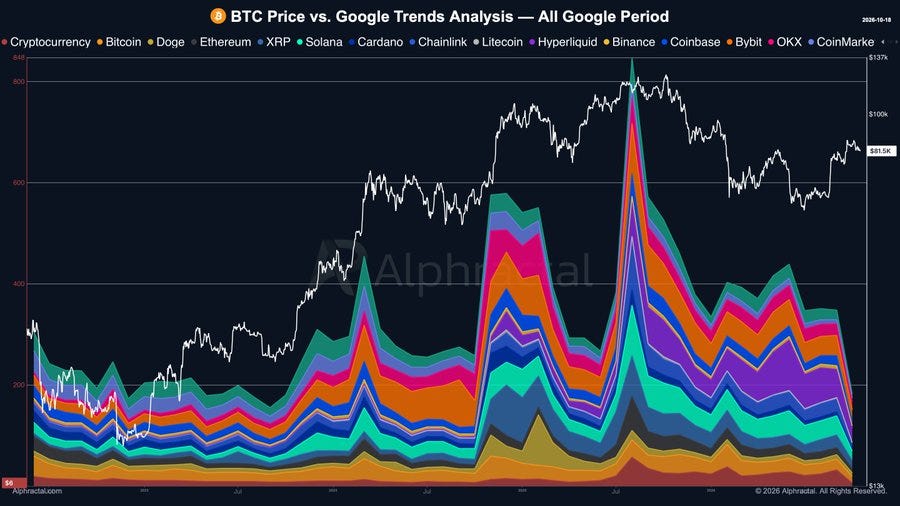
Is crypto losing the spark it once had? Google Trends points to a decline in search interest, with cryptocurrency-related searches reaching their lowest level since 2023. The current market structure also resembles conditions seen in the fourth quarter of 2022 and the first quarter of 2023.

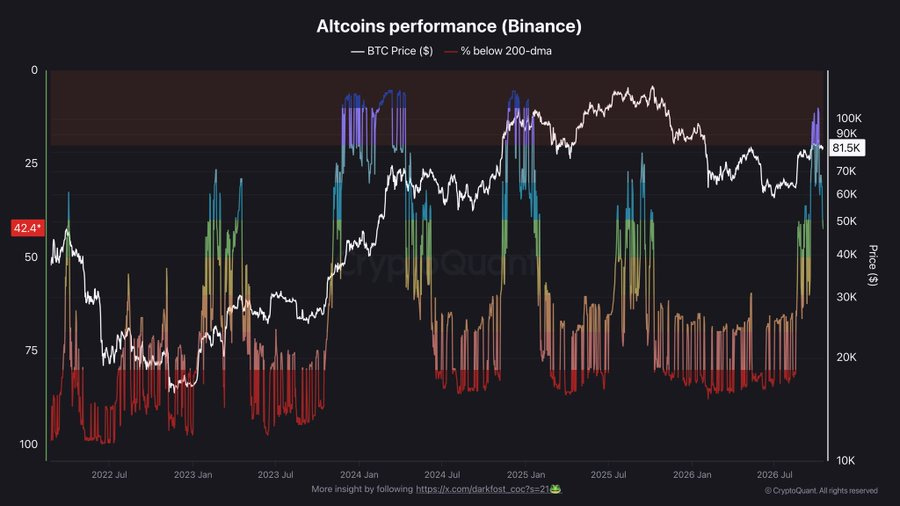
The decline in interest comes as altcoins struggle to sustain the gains recorded during a brief rally between late August and early October. Crypto analyst Darkfost noted that the market’s recent strength is fading, with more altcoins slipping out of their upward trends.
Altcoin Momentum Begins to Reverse
The change is becoming clearer among Binance-listed altcoins. Between late August and early October, the proportion of these assets trading below their 200-day moving average (200-DMA) dropped from 81% to less than 10%. At the height of the rally, fewer than one in ten remained below this level.
More than $814 billion flowed into altcoins during the same period, coinciding with the market’s strong performance. Since then, however, the direction has shifted.
The share of Binance-listed altcoins trading below their 200-DMA has risen to 48.4%. Almost half of the assets tracked have now slipped beneath the level, reversing much of the improvement seen during the earlier rally.
Altcoin Outflows Exceed $134 Billion
The market’s weakening momentum is also reflected in recent capital movements. Altcoins have recorded more than $134 billion in outflows over the past 15 days, with investors taking quick profits likely contributing significantly to the decline.
The latest figures show how quickly conditions can change in the altcoin market as investor sentiment shifts and earlier gains begin to fade.
However, weak performance and reduced attention may also be worth considering when evaluating the market. Historical patterns suggest that periods of low interest and poor altcoin performance can present opportunities to assess potential exposure to the sector. That said, the current conditions do not guarantee that prices will recover.

🚨Bitcoin Eyes $90K as ETF Withdrawals Put Investors on Alert
Bitcoin is facing mixed signals as institutional investors pull money from spot ETFs while technical analysts watch for a potential price breakout. The funds recorded $82.39 million in net outflows over 24 hours, yet some analysts believe BTC could still climb towards $90,000 if its current price structure holds.

The coming days may reveal whether investors are simply taking profits or becoming more cautious about the market’s direction.
📉 ETF Outflows Raise Questions About Institutional Demand
Data from SoSoValue shows that Bitcoin ETFs lost $82.39 million between October 16 and 17, 2026. Despite the withdrawals, total assets held by these funds remained substantial at $104.29 billion.
Ethereum ETFs experienced similar pressure, recording $69.68 million in daily net outflows. Concerns surrounding Federal Reserve decisions and inflation have added uncertainty, encouraging some investors to reduce their exposure to crypto assets.
However, a single day of withdrawals does not necessarily signal a sustained decline. Investors will need to watch subsequent fund flows to determine whether institutional demand is weakening or the market is experiencing a temporary pause.
📈 Technical Analysts See a Possible Route to $90,000
Bitcoin’s price chart is drawing attention because of a falling wedge formation, which technical traders often interpret as a potentially bullish pattern.
Analysts including Mister Crypto and Crypto Rover are watching for a breakout above the current consolidation range. If buying pressure strengthens, $87,000 could be the next resistance level, followed by the psychological $90,000 mark.
The downside risk remains important. Should Bitcoin lose its support around $81,000, continued selling pressure could push prices towards the $70,000 range. That scenario would challenge the bullish outlook rather than guarantee another buying opportunity.
🔮 Could Bitcoin’s Halving Cycle Support Another Rally?
Longer-term bulls are also looking at Bitcoin’s historical halving cycles. One theory focuses on a roughly 500-day timing pattern around halvings, suggesting that substantial price advances can emerge during the later stages of a cycle.
Supporters believe a recovery in ETF inflows, combined with a more favourable Federal Reserve outlook, could strengthen Bitcoin’s chances of another rally. A reversal in bearish positioning could add momentum if prices break above resistance.
Still, historical patterns cannot guarantee future returns, and the next Federal Reserve decision remains an important uncertainty.
For now, Bitcoin faces a clear test: whether demand can overcome cautious institutional flows and push the price beyond its current range. A move towards $90,000 remains possible, but it depends on confirmation from price action and renewed buying pressure.

Weekly Recap: The Headlines That Made a Splash!

Like every Monday, here’s your pick of last week’s crypto news that you absolutely shouldn’t have missed!
However, if you’re the type who likes to stay updated every day, we’ve got just the thing for you. We’ve set up a Daily on our Substack. In just five minutes, you’ll be fully in the loop on everything happening in the crypto world! 😎
⚡ Cardano’s Leios Upgrade Targets a Major Leap in Transaction Capacity
Cardano founder Charles Hoskinson believes the blockchain will be complete once the Leios upgrade is deployed. Designed to increase transaction throughput without sacrificing decentralisation, Leios could deliver processing capacity between two and 30 times higher than current levels, according to project estimates. A test conducted in September demonstrated throughput of around 1,000 transactions per second. The public Musashi Dojo testnet, launched on June 23, is progressing through five phases and remains under evaluation. Deployment on the mainnet is expected before the end of the year, subject to testing and technical decisions. Some community members, however, argue that Cardano cannot be considered complete until Leios, Hydra and other roadmap components are operating on the main network.
👉 Read the article
🔐 Vitalik Buterin Adds Tor and Private Payments to an AI Agent
Ethereum co-founder Vitalik Buterin has developed an experimental setup designed to make AI-agent interactions harder to trace. His “paranoiac mode” routes conversations through separate Tor circuits, generates dummy network traffic and uses a locally run model to rephrase prompts before sending them to a remote AI provider. It also incorporates zkAPI, a system that lets users fund private usage credits through ETH or USDC deposits without directly exposing the payment identity behind each request. The agent runs in an isolated environment to limit access to the rest of the computer. Buterin acknowledges that the approach increases latency and does not eliminate every privacy risk, including possible traffic-timing analysis. He has also considered whether a specialised mixnet could provide stronger protection.
👉 Read the article
🇷🇺 Russia Sets July 2027 Deadline for Direct Crypto Trading Between Individuals
Russia plans to prohibit direct cryptocurrency transactions between individuals from July 1, 2027, requiring buyers and sellers to use authorised intermediaries such as regulated brokers or exchanges. The Bank of Russia confirmed the deadline in an October 12 regulatory FAQ. The change would affect a market where peer-to-peer trading has been widely used to purchase assets such as USDT, including through direct bank transfers to sellers. Under the new framework, non-qualified investors will also need to pass a test and face an annual purchase limit of 300,000 rubles per intermediary. Qualified investors will not face that cap. The rules also restrict transfers from certain regulated crypto accounts to personal non-custodial wallets, while banks, including Sberbank and VTB, prepare crypto services.
👉 Read the article
🏛️ Trump’s Crypto Council Loses Its Executive Director as Clarity Act Stalls
Patrick Witt has left his position as executive director of Donald Trump’s White House Crypto Council after his temporary assignment expired. He confirmed his departure on October 15 and said he would return to the private sector. No successor has been publicly announced, following earlier departures by Bo Hines, David Sacks and Harry Jung. Witt had played a key role in negotiations over the Clarity Act, a proposed federal framework intended to clarify the responsibilities of the SEC and CFTC in regulating digital assets. The bill failed to advance in a Senate procedural vote on September 15, receiving 49 votes in favour and 50 against, short of the 60 required. Disagreements over stablecoin rewards and politicians’ crypto-related conflicts of interest remain among the main obstacles.
👉 Read the article
₿ Michael Saylor Sees Bitcoin Reclaiming $100,000 After a Market Bottom
Michael Saylor believes Bitcoin has reached a low below $60,000 and could resume its upward trajectory, although he gives no timeline for a return above $100,000. In an interview with Bloomberg Television, the strategy executive chairman cited banking adoption, clearer regulation, tokenised securities and digital credit as factors supporting his outlook. He also forecasts annual Bitcoin growth of 20% to 30% over the next 20 years. Strategy holds 848,250 BTC following a purchase announced on October 12. Prediction markets, however, assigned only a 27% probability to Bitcoin returning to $100,000, while Strategy faced a separate pending decision over its eligibility for MSCI stock indexes.
👉 Read the article
🤝 Nine Crypto Organizations Unite to Prepare Blockchains for Quantum Threats
Nine crypto organizations have formed the Quantum Alliance to develop shared standards for protecting blockchains and wallets against future quantum computers. The group estimates that around 6.04 million BTC—roughly 30.2% of the existing supply—have public keys visible on the blockchain, potentially exposing them to future attacks. No computer available today can recover Bitcoin private keys this way. The alliance plans to coordinate work on blockchain migration, post-quantum cryptography, wallet security and cross-network compatibility. Forecasts for when a practical quantum threat could emerge vary, with some pointing to 2028 and others to the 2030s. Moving older or inactive bitcoins to new security systems presents an additional challenge.
👉 Read the article
⚙️ Ethereum Tests a 3.3-Fold Gas Limit Increase Ahead of Glamsterdam
Ethereum is preparing to raise its gas limit from 60 million to 200 million per block as part of the upcoming Glamsterdam upgrade, a 233% increase. The new limit has been active on the Sepolia testnet since October 6, with deployment on Hoodi scheduled for October 26. No mainnet activation date has been confirmed. The upgrade combines higher block capacity with changes designed to improve validation and allow independent transactions to be processed in parallel. Early Sepolia tests recorded gas consumption between 52 million and 92 million per block, below the new ceiling. Developers must also address the additional computing, storage and bandwidth requirements that larger blocks could impose on node operators.
👉 Read the article
📉 Bitcoin ETFs Lose $910 Million as BTC Falls Below Investors’ Average Cost
US spot Bitcoin ETFs recorded nearly $910 million in net outflows over two weeks, with $681.1 million withdrawn in the first week and another $228.6 million in the second. October’s balance turned negative by around $615 million, despite starting with $293 million in inflows. On October 7 alone, investors withdrew $484.9 million. Bitcoin also slipped below the estimated average purchase price of ETF investors, around $82,300, trading near $81,590 on Friday. Derivatives markets faced further pressure, with almost $950 million in leveraged positions liquidated in 24 hours, about 90% of them bullish bets. Since their launch in January 2024, however, US spot Bitcoin ETFs have accumulated roughly $57.3 billion in net inflows.
👉 Read the article
That’s the end of our weekly roundup! 😄
A big thank you for reading. We’ll see you next Monday with even more juicy news from the crypto world!
The Newsletter does not provide investment advice, nor does it offer recommendations to buy or sell financial securities. Any opinions or views that the Newsletter may express in the course of its research activities, particularly regarding markets and/or financial instruments, cannot be held financially liable. Any paid promotions will always be clearly indicated so as not to mislead the reader.
Thank you for following our weekly newsletter! To stay at the heart of the news, subscribe for free to our daily edition and receive each day a summary of the most important events in the crypto ecosystem.
