



The News Tribune Weekly!
Great to have you here for another edition of our weekly newsletter, where we explore the most relevant and fast-moving topics shaping our economic and digital world.

Without further ado, let’s move on to point 1!

XRP Falls Deeper Into Bearish Territory
XRP is facing renewed selling pressure as the broader cryptocurrency market remains firmly in the red, pushing the token significantly below its previous all-time high. The asset is now down 71.7% from its July 2025 peak of $3.66, with the decline also weighing heavily on market sentiment.
According to on-chain analytics firm Santiment, negative commentary surrounding XRP surged last week as the token struggled to stage a meaningful recovery. Discussions across social media and crypto communities reached their most bearish levels in roughly three months, highlighting growing pessimism among investors regarding XRP’s near-term outlook.
With the price now trading below the $1 mark, retail sentiment could remain weak, particularly after such a prolonged correction. However, the growing negativity does not tell the entire story.
XRP Ledger Activity Offers a Different Signal
While sentiment has deteriorated, activity on the XRP Ledger has moved in the opposite direction. XRP recorded 49,929 active addresses over a 24-hour period, marking its highest level of network activity in more than two months.
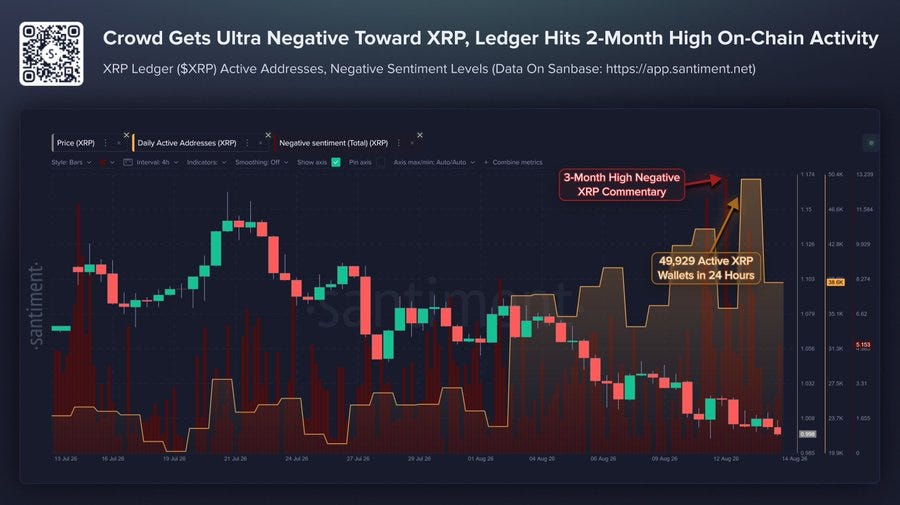
The increase is particularly notable because activity had previously fallen toward its lowest levels of 2026 earlier in July. A rebound in participation could therefore provide an important counterpoint to the prevailing bearish mood, especially if network usage continues to strengthen.
This divergence between price action and on-chain activity suggests that investors should look beyond sentiment alone when assessing XRP’s outlook. Although elevated network participation does not guarantee a price recovery, it indicates that interest in the asset has not completely disappeared.
Whales Continue to Accumulate XRP
Large holders are also showing signs of confidence despite the market downturn. On August 13, crypto analyst Ali Martinez reported that whales had accumulated more than 72 million XRP.
The accumulation adds another layer to the developing picture. While retail investors remain increasingly fearful, larger holders appear willing to buy into the weakness. If XRP can maintain its current structure and attract renewed demand, the extreme pessimism surrounding the token could eventually create the conditions for a recovery.
For now, however, XRP remains under significant pressure, with sentiment, price performance, and broader market weakness keeping the bears firmly in control.

🪙 Bitcoin’s 21 Million Limit Faces a New Test as Mining Rewards Shrink
Bitcoin’s famous 21 million coin limit is facing renewed scrutiny, not because the cap is about to change, but because developers are increasingly thinking about what happens when new Bitcoin issuance eventually stops. Developer Peter Todd has suggested keeping a small mining reward after 2140, while Blockstream CEO Adam Back strongly disagrees. For now, there is no active plan to alter Bitcoin’s supply rules, but the debate raises an important question about how the network will pay miners in the distant future.

⛏️ What happens when Bitcoin rewards disappear?
More than 20 million BTC have now been mined, leaving roughly 1 million coins to be created. Miners currently receive 3.125 BTC per block, with the reward cut roughly every four years. If that schedule continues, the final fractions of Bitcoin should be issued around 2140.
Once that happens, miners will have to rely entirely on transaction fees. Todd argues that fees could be unpredictable, potentially making Bitcoin mining less attractive and creating incentives for miners to manipulate the blockchain in search of more profitable transactions.
His proposal is to introduce a small, ongoing issuance to provide miners with a more consistent source of income. He also points to permanently lost Bitcoin as another reason for considering the idea.
⚔️ Adam Back pushes back on the proposal
Back has rejected the suggestion, warning that arguments for changing Bitcoin’s monetary rules could make a controversial modification appear more acceptable to users who do not fully understand its consequences.
The disagreement comes after the recent BIP-110 controversy, which received only about 2.53% miner support, well below its proposed 55% threshold. Back sees the latest supply debate as another example of how changes to Bitcoin’s rules can generate strong resistance.
🔐 Changing the cap would be far from simple
Increasing Bitcoin’s supply would require a hard fork, meaning the network could split between users who accept the new rules and those who continue using the existing version.
That makes the 21 million limit more than a technical setting. It has become a central part of Bitcoin’s appeal as a scarce digital asset. While questions about future mining economics will become more important as block rewards decline, 2140 is still a long way off.
For now, Bitcoin remains capped at 21 million, and changing that rule would require much more than simply updating the software.

Weekly Recap: The Headlines That Made a Splash!

Like every Monday, here’s your pick of last week’s crypto news that you absolutely shouldn’t have missed!
However, if you’re the type who likes to stay updated every day, we’ve got just the thing for you. We’ve set up a Daily on our Substack. In just five minutes, you’ll be fully in the loop on everything happening in the crypto world! 😎
🪙 Metaplanet launches BitBonds as CEO denies Bitcoin sale
Metaplanet has launched BitBonds, a four-series bond program worth 200 million yen, or about $1.3 million, with annual coupons ranging from 4% to 4.3% and three-year maturities. The bonds are unsecured and not backed by Bitcoin, while repayment depends on the company's solvency and Bitcoin's price movements. The announcement came after transfers of 3,881 BTC and 5,014 BTC from Metaplanet wallets sparked speculation about a possible sale. CEO Simon Gerovich denied that any Bitcoin had been sold.
👉 Read the article
⚠️ MSCI could remove Strategy from its global indices
MSCI is considering a new methodology that could exclude Strategy from several global indices. Instead of directly targeting companies based on their cryptocurrency holdings, the proposed framework identifies companies whose value depends heavily on accumulated assets rather than traditional operations. Five criteria examine operating assets, operating expenses, operating cash flow, fair-value changes and reliance on external financing. MSCI's simulation using May 2026 data would have removed Strategy, Yellow Cake and Metaplanet from the MSCI ACWI IMI.
👉 Read the article
🏛️ Trump brings crypto, AI and prediction markets to the White House
Donald Trump is preparing a White House meeting bringing together leaders from crypto, artificial intelligence and prediction markets. Executives from Coinbase, Ripple, Gemini and Robinhood are expected alongside representatives from Polymarket, Kalshi, CME Group, Nasdaq, ICE and DTCC. Treasury Secretary Scott Bessent, Commerce Secretary Howard Lutnick and CFTC Chairman Mike Selig are also expected to attend. Discussions will focus on creating a clearer federal regulatory framework and addressing the overlap between US regulatory agencies.
👉 Read the article
📉 Easing inflation pressures reshape the Fed's September outlook
Expectations for a Federal Reserve rate hike in September have fallen sharply after new US economic data showed easing price and consumer pressures. The July Producer Price Index was unchanged, against expectations for a 0.2% increase, while retail sales fell 0.6% to $763.6 billion. CME FedWatch data put the probability of a September rate hike at just over 32%, down from about 60% one week earlier. US debt and renewed geopolitical tensions remain additional factors for monetary policy.
👉 Read the article
🔄 Andre Cronje says DeFi is becoming something different
Andre Cronje argues that much of what is still called DeFi no longer meets the original definition of decentralized finance. For him, true DeFi requires three conditions: decentralization, immutability and the absence of intermediaries. Yet many protocols now rely on teams, risk committees or other groups that can modify parameters, pause activity or decide which assets are accepted. Cronje instead uses the term “on-chain finance” for systems that operate on blockchains but retain these forms of human intervention.
👉 Read the article
⛓️ Ethereum narrows Hegotá upgrade shortlist to 66 proposals
Ethereum is sorting the proposals considered for Hegotá, its planned 2027 upgrade, with 66 still in contention as of August 16. FOCIL, or EIP-7805, is already marked as “Scheduled” and aims to strengthen censorship resistance by allowing a validator committee to require certain transactions to be included in a block. Three other proposals — EIP-8141, EIP-8250 and EIP-8272 — could provide tools for privacy applications through new transaction structures, independent nonces and recent cryptographic roots. None of the three creates a ready-to-use private mode for Ethereum.
👉 Read the article
🚨 Coldcard hack triggers $15 billion in Bitcoin transfers
The Coldcard hack was followed by a much larger movement of Bitcoin as holders transferred around 233,000 BTC, worth roughly $15 billion, to other wallets. The transfers came from wallets that had held their coins for more than 155 days. Some Ledger and Trezor users also moved funds into multisignature setups after the incident. The original Coldcard vulnerability had remained in public code since 2021 and was reportedly identified by an attacker using AI.
👉 Read the article
🤝 Apple develops a China-focused AI model with Alibaba
Apple has trained an AI model specifically for the Chinese market with technology from Alibaba and Baidu. The model is intended to power Apple Intelligence on iPhone, iPad, Mac and Vision Pro devices sold in China. In July, China's Cyberspace Administration registered Apple's generative AI service, which could make Apple the first foreign company authorized to operate its own proprietary AI model in the country. Until now, Apple had relied on third-party AI models for its Chinese devices.
👉 Read the article
That’s the end of our weekly roundup! 😄
A big thank you for reading. We’ll see you next Monday with even more juicy news from the crypto world!
The Newsletter does not provide investment advice, nor does it offer recommendations to buy or sell financial securities. Any opinions or views that the Newsletter may express in the course of its research activities, particularly regarding markets and/or financial instruments, cannot be held financially liable. Any paid promotions will always be clearly indicated so as not to mislead the reader.
Thank you for following our weekly newsletter! To stay at the heart of the news, subscribe for free to our daily edition and receive each day a summary of the most important events in the crypto ecosystem.
