



Hello Cointribe! 🚀
Today is Saturday, July 19, 2025, and as every day from Tuesday to Saturday, we summarize for you the news from the last 24 hours that you couldn’t miss!
But first…
✍️ Cartoon of the day:

A quick look at the market…
🌡 Weather:
🌧️ Rainy
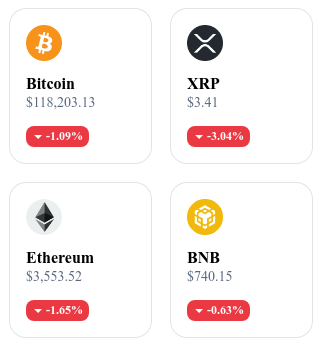

24h crypto recap! ⏱
🐶 Memecoins booming, Bonk taking the lead
The total capitalization of memecoins jumped by 32%, driven by Bonk, whose valuation climbed 185% in two weeks, placing it among the top 5 fastest-growing cryptocurrencies. This resurgence strengthens speculative interest in this often impulsive but lucrative segment.
🏦 US banks ready to launch their own stablecoins
Bank of America, Citigroup, JPMorgan, and other major US banks are preparing stablecoins aimed at optimizing interbank and cross-border payments, amid a favorable regulatory environment like the GENIUS Act. This incursion by traditional institutions redefines the role of stablecoins in the financial system.
🇫🇷 France wants to leverage nuclear energy to mine Bitcoin
A bill proposes using France's excess nuclear energy to mine Bitcoin, with a 5-year pilot phase capable of generating up to $150M per gigawatt. The initiative aims to capitalize on electricity surpluses and revive the economy in certain regions.
🇺🇸 Trump signs the Genius Act, first US stablecoin law
President Trump officially signed the "Genius Act," paving the way for federal regulation of stablecoins, accompanied by the Clarity and Anti‑CBDC laws, passed respectively by 308‑122 and 294‑134 in the House. This framework strengthens the confidence of banks like JPMorgan, Citi, and BofA in integrating tokenized payment solutions.

Crypto of the day: Avalanche (AVAX)
🧠 Technology and innovation
Avalanche is a Layer 1 blockchain optimized to offer near-instant finality (less than one second) and a very high throughput (up to 4,500 TPS). Its strength lies in its modular triple-chain architecture:
X-Chain: UTXO asset management (creation/exchange of tokens)
C-Chain: EVM-compatible for smart contracts (via the AVM machine)
P-Chain: Staking management and network coordination
It also allows creating custom subnets, offering exceptional flexibility: dApps, DeFi, enterprises, Governments, etc. This hybrid model blends performance, Ethereum compatibility, and network sovereignty.
💰 AVAX – The native crypto: utility, distribution, advantages
The AVAX token fulfills fundamental functions:
Serves as gas (transaction fees) on X-Chain, C-Chain, and P-Chain.
Is required for staking, ensuring security through token locking.
Provides access to governance, allowing participants to influence the protocol.
Is used as a unit of account in subnets, facilitating the development of customized environments.
Thanks to these functions, AVAX structures the Avalanche ecosystem and encourages innovation while aligning participants’ interests.
📊 Recent performance (July 19, 2025)
Current price: $23.66 USD
24h change: –2.29%
Market capitalization: ≈ $9.957 billion
CoinMarketCap rank: #17
Circulating supply: 422,275,285 AVAX
24-hour trading volume: ≈ $599.5 million

Crypto: $4 trillion capitalization, a historic milestone
The crypto market has just crossed a major psychological threshold: $4 trillion in capitalization. This achievement, driven by giants such as Bitcoin, Ethereum, and XRP, reflects the progressive maturation of the crypto ecosystem. While this figure marks a peak, it also raises questions about capital concentration, structural market evolution, and current investment dynamics.
Bitcoin, Ethereum, and XRP capture most of the value
Bitcoin remains undoubtedly the main driver of this new peak. With over 62% of total capitalization, it draws investors’ attention and concentrates most inflows. This dominance is accompanied by renewed confidence in its role as a store of value and anti-inflation asset in an uncertain economic environment.
Ethereum maintains a strong position with 10.8% market share. Its robustness is explained by the central role it continues to play in the ecosystem of decentralized applications and programmable finance. Although its growth has slowed compared to previous periods, it retains its legitimacy as a benchmark infrastructure.
XRP, often relegated to the media background, establishes itself as the third player in this dynamic. Despite past regulatory uncertainties, its attractiveness to an institutional audience is confirmed. The polarization of capital toward these three assets marks a market consolidation phenomenon at the expense of an increasingly fragmented altcoin universe.
Growing decentralization and market maturity
Beyond simple capitalization growth, the crypto market shows structural transformation signals. According to the latest data from the CoinGecko report, trading volumes on centralized exchanges (CEX) fell by 27.7%, while those on decentralized platforms (DEX) rose by 25.3%. This evolution reflects a shift in user behavior, who now favor transparency and non-custody.
This redirection of flows is accompanied by increasing alignment with traditional financial market logics. The interconnection between crypto assets and classic finance is strengthening, both in valuation mechanisms and investment strategies. The market, while retaining its disruptive nature, is entering a phase of gradual normalization, with cycles influenced by global macroeconomic factors.
Cryptocurrencies, once perceived as marginal assets, now establish themselves as integral components of diversified portfolios. This new reality implies a strategic repositioning for emerging projects, called upon to justify their technological and economic relevance in face of now consolidated leaders.
The $4 trillion milestone crystallizes structural tensions and promises of the crypto ecosystem. While major assets stand as pillars of a stabilized market, the transition to decentralized infrastructures paves the way for a new era of innovation and financial normalization. The next step will not only be quantitative but decidedly qualitative.
