



Hello Cointribe! 🚀
Today is Friday, 28 November 2025, and as every day from Tuesday to Saturday, we bring you a summary of the key news from the last 24 hours that you shouldn’t have missed!
But first…
✍️ Cartoon of the day:
A quick look at the market…
🌡 Weather:
🌧️ Rainy

24h crypto recap! ⏱
💼 BitMine extends Ethereum accumulation with an additional $44.34M purchased
BitMine has acquired $44.34 million worth of Ethereum through the wallet “0xbd0…E75B8”, strengthening its position as the largest corporate holder of ETH. The company now holds 3.63 million ETH, around 3% of the total supply, with a stated goal of reaching 5%.
👉 Read the full article
🏦 Amundi launches its first partially tokenized money market fund
Amundi has tokenized a portion of its money market fund “Amundi Funds Cash Eur”, while keeping the traditional distribution model for the remaining share. This fund, available since 4 November, combines the advantages of blockchain — traceability, instant execution, 24/7 liquidity — with the usual infrastructure.
👉 Read the full article
⛓️ Ethereum raises its gas limit to 60 million — first increase in 4 years
The Ethereum blockchain has seen its gas limit increased to 60 million, a first in four years, which could enhance its transaction processing capacity. This adjustment reflects network upgrade efforts to handle a growing volume of smart contract activity.
👉 Read the full article
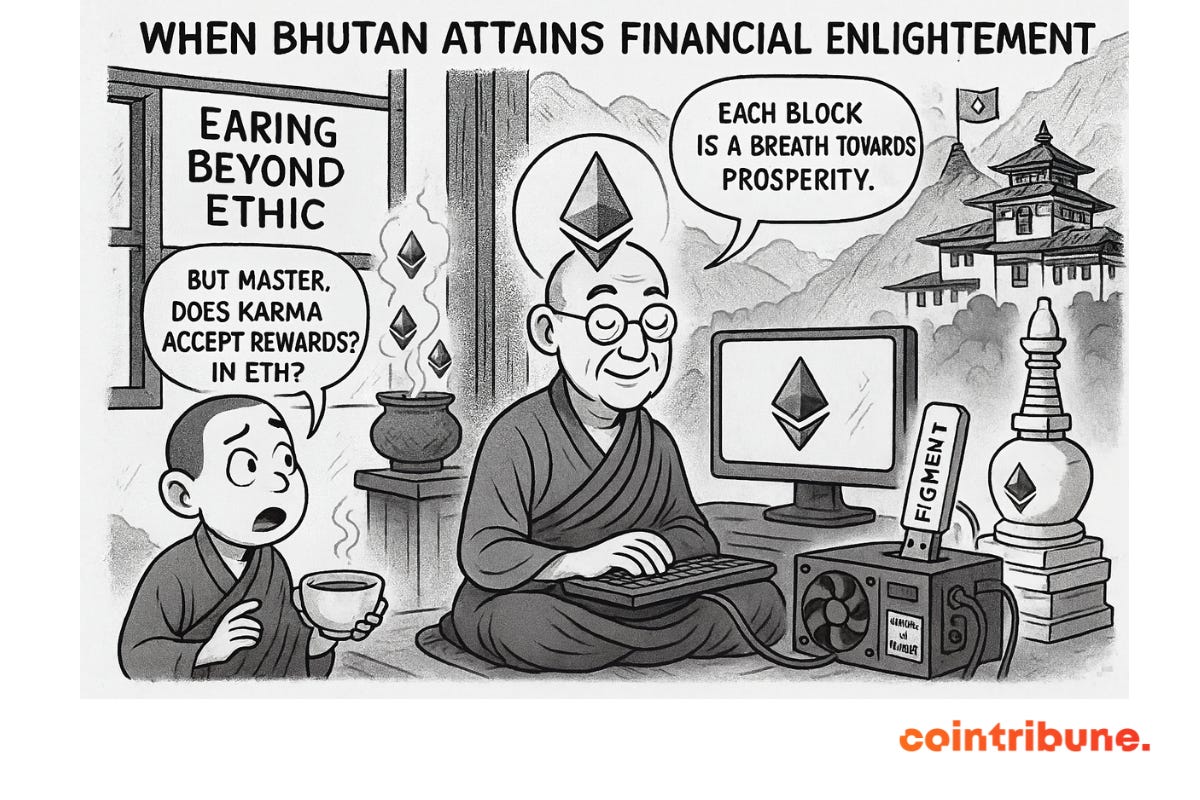
🇧🇹 Bhutan bets on Ethereum: nearly $1M in ETH staked via Figment
Bhutan has staked the equivalent of $1 million in ETH through the Figment platform, marking a notable commitment by a nation toward the Ethereum blockchain. This move illustrates the increasing interest of public entities in staking mechanisms and Web3 infrastructure.
👉 Read the full article

Crypto of the day: Injective (INJ)
🧠 Innovation and added value
Injective is a Layer-1 blockchain designed to provide an ultra-fast infrastructure dedicated to decentralized finance (DeFi).
It is based on an execution engine optimized for decentralized order books, enabling the creation of derivative markets, spot markets, futures and complex products — all without gas fees for users.
Injective benefits from compatibility with the Cosmos ecosystem (IBC), allowing interoperability with networks such as Osmosis, Cosmos Hub or Kava.
Its architecture combines speed, low cost and modularity, making it one of the most advanced protocols for building fully on-chain trading applications.
💰 The token
INJ is the native token of the network. It is used to:
pay transaction fees (near zero),
participate in DeFi module governance,
secure the blockchain through Proof-of-Stake staking,
power the creation and execution of on-chain derivative markets.
Injective also introduces a weekly burn mechanism, where part of the fees generated by protocols is destroyed, creating long-term deflationary pressure.
📊 Real-time performance (CMC)
💵 Current price: $6.07
📉 24h change: –2.87 %
💰 Market cap: $607.8M
🏅 CoinMarketCap rank: #86
🪙 Circulating supply: 99.97M INJ
📊 Trading volume (24h): $85.82M

Monero surges, Zcash plunges!
In a crypto market seeking new dynamics, privacy-focused cryptocurrencies have just experienced a strikingly contrasted move. While Monero (XMR) is soaring amid speculation, Zcash (ZEC) is suffering a sharp drop, illustrating the internal tensions of a sector often misunderstood, yet with strong potential. Should this be seen as mere volatility, or the sign of deeper repositioning among privacy assets?
Monero boosted by speculation on derivatives
Over the past week, Monero has seen its price jump by more than 23%, drawing analysts’ attention. What is intriguing is that this rise is not tied to any fundamental news: no new partnership, no technological upgrade, no strategic announcement. The driver behind this surge appears to lie elsewhere, in the highly speculative arena of derivatives markets.
Indicators on futures activity show sustained momentum. The positive bid-ask delta on these products, combined with growing volume, suggests leveraged traders are taking bullish positions. Meanwhile, the absence of significant movement on the spot market indicates that this rally is not supported by organic demand growth.
This type of market behavior highlights the risks of short-lived bubbles where prices rise quickly due to leverage, without durable fundamentals. If long positions were to unwind, Monero could face an equally brutal reversal. In other words, this is not necessarily renewed confidence in Monero’s privacy features, but rather a purely technical and opportunistic move.
Zcash slides, but keeps strong cards in hand
Conversely, Zcash has dropped 25% over the same period — a decline that may seem alarming, but does not necessarily signal a loss of faith in the project. According to some analysts, this correction results from capital rotation: investors shifting from one privacy asset to another in an arbitrage logic. Current volatility is therefore less a structural rejection than a short-term adjustment in trader positioning.
Unlike Monero, Zcash benefits from significant institutional leverage. Grayscale has submitted a request to convert its ZEC Trust into an ETF. If approved, Zcash would gain visibility and legitimacy in regulated markets. This would be a strategic turning point, capable of redefining its role in the privacy-oriented crypto landscape.
This institutional interest could attract a broader audience — provided that regulators do not intensify pressure on anonymity-enhancing assets. The challenge lies in balancing privacy and compliance, an equilibrium that Monero — often seen as more radical — approaches very differently.
The contrast between Monero and Zcash in this market sequence illustrates the complexity of privacy coins, often caught between speculative forces, regulatory constraints and user expectations. Monero attracts with its image as a pure anonymity stronghold, but its recent breakout rests on fragile technical grounds. Zcash, meanwhile, appears in short-term decline but is steadily building stronger institutional legitimacy through recognized financial products. This positioning may offer it greater resilience in the months ahead, especially if privacy coins come under stricter regulation.
