


Hello Cointribe! 🚀
Today is Tuesday, July 29, 2025, and as every day from Tuesday to Saturday, we sum up for you the news of the last 24 hours that you should not have missed!
But first…
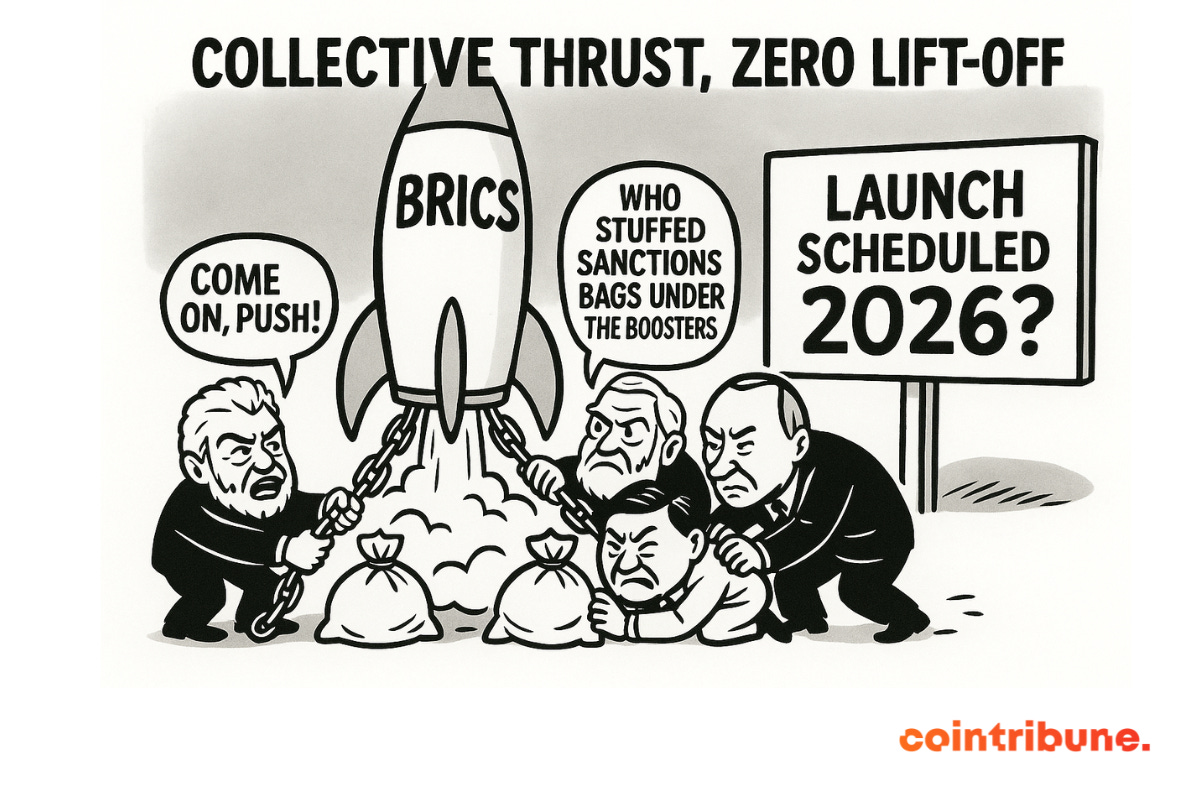
✍️ Cartoon of the day:
A quick look at the market…
🌡 Weather:
🌧️ Rainy
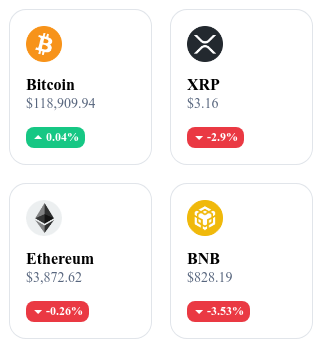

24h crypto recap! ⏱
🌍 BRICS leaders agree on a common currency in 2026
At the 17th summit of July 2025, the BRICS member countries adopted a roadmap to launch a unified currency in 2026. This initiative aims to use BRICS Pay and develop trade in local currencies to reduce dependence on the dollar.
🏦 Strategy suspends its Bitcoin purchases due to high price
During the last week of July 2025, Michael Saylor's company Strategy did not acquire any bitcoin while the price remained above $118,000. Its monthly purchases dropped by 39% to 10,445 BTC, while a $2.5 billion preferred stock issuance strengthens its treasury.
⚡️ Bitcoin hashrate nears an all-time high
In the last 24 hours, Bitcoin's hash rate almost reached its record level, reflecting a significant increase in computing power. This renewed activity floods the network with reinforced security and improves the profitability of mining operations.
🐋 SharpLink becomes the second largest institutional holder of Ethereum
SharpLink acquired 77,210 ETH for $295 million, surpassing Ethereum's net monthly issuance over the last 30 days. With a portfolio of $1.69 billion in ETH, the company consolidates its position as one of the main institutional investors.

Naoris Protocol Listing: The $NAORIS token arrives to secure post-quantum Web3
Facing the advent of quantum computing, Naoris Protocol deploys a decentralized cybersecurity infrastructure from the start to resist future attacks. Natively integrating post-quantum algorithms validated by NIST (Dilithium-5, KEMs) via its "Sub-Zero Layer" compatible with EVM –without hard fork nor migration– the protocol also relies on a dPoSec consensus and a swarm AI network to detect and neutralize threats in real time. Its testnet has already processed over 98 million transactions and blocked 461 million threats, demonstrating the effectiveness of its solution.
The $NAORIS token, whose TGE will take place on July 31, 2025, constitutes the core of the economy of this digital security platform. With a maximum supply of 4 billion tokens and 4% reserved for public sale (immediate unlocking), it allows to:
Participate in node staking to strengthen the dPoSec consensus
Receive rewards for integrity validation
Access cybersecurity services (anti-phishing alerts, smart contract verification)
Take part in decentralized governance
This tokenomics is designed to sustainably align the interests of validators, investors, and technological partners.
To celebrate this major milestone, Cointribune offers you a Read to Earn quest from July 31 to August 13, 2025. Explore step by step the universe of Naoris Protocol, take on educational challenges, and try to win your share of over $2,500 in prizes:
$1,000 in $NAORIS tokens
5 × Ledger Nano S Plus
5 × hoodies, 5 × t-shirts, 5 × caps, and 5 × Naoris mugs
Join us from the launch and become an actor in the post-quantum security of Web3!
Crypto of the day: Internet Computer (ICP)
🧠 What innovation and added value?
Internet Computer, developed by the DFINITY Foundation, pushes the limits of Web3: its ambition is to host Web applications directly on the blockchain, eliminating the need for centralized servers. Thanks to an original architecture based on chain-key cryptography, combined with ultra-secure consensus, ICP enables execution of "canisters" (self-hosted smart contracts) with very low latency and without centralized cloud dependency. The protocol is designed to support Internet-scale applications: social networks, DeFi, NFT, DAO, and even distributed public services.
Everything runs autonomously via the Reverse Gas Model: developers burn ICP to obtain "cycles" necessary for canister operation. The network is administered by the Network Nervous System (NNS), a fully on-chain governance system.
💰 The ICP token: utility, distribution, and benefits for holders
The ICP token is the core of the economic and governance model:
It powers on-chain governance through NNS neurons, allowing to propose or vote on changes.
It is burned in exchange for cycles, the currency that powers computation and storage in canisters.
It is used to reward validator nodes, ensuring network security and resilience.
It was distributed via institutional sales, endowment funds, and community allocation, with a total active supply of ~536 million tokens.
📊 Recent performance (July 29, 2025)
Current price: $5.66 USD
24h variation: –5.32 %
Market capitalization: ≈ $3.037 billion USD
Rank on CoinMarketCap: #37
Circulating supply: 536,171,207 ICP
Trading volume (24h): ≈ $103.7 million USD

Millions thanks to memecoins: the dizzying figures of Murad Mahmudov
In a few weeks, Murad Mahmudov, former analyst and seasoned investor, turned a capital of $1.8 million into a fortune of $68 million.
Beyond the feat, this trajectory raises questions about market dynamics, between innovation, virality… and suspicions of manipulation.
SPX6900 and Mahmudov's strategy: between boldness and suspicions
The highlight of this financial performance rests on an unknown token: SPX6900. Acquired at a unit price of $0.01036, this memecoin saw its value climb up to $2.24, recording a spectacular increase of 10,500%. Result: an estimated profit of $66 million, with an initial investment around $1.86 million. While the financial feat is undeniable, the practices surrounding this operation raise major questions.
Research conducted by DropsTab and ZachXBT, a recognized on-chain analyst, indicate that Mahmudov might be linked to 11 distinct wallets, possibly used to spread the purchase, enhance anonymity, and limit the impact of his actions on visible markets. The case gained momentum with the MIN token, for which he would have secured 1% of the total supply before promoting it. This strategy recalls so-called "pre-pump" mechanics, where an investor influences public perception after quietly taking position.
Memecoins and platforms: Pump.fun dethroned, Solana in turmoil
This individual success is part of an underlying trend: the rise of memecoins. Within one month, the sector's total capitalization jumped from $55 to $85 billion, a growth of 54%, before stabilizing around $78 billion, still up 41% year-to-date.
The Solana blockchain now concentrates a large part of this excitement. Two platforms compete for most of this activity: Pump.fun, long leader, is now surpassed by LetsBonk, whose daily volume reached $1.04 million, against $533,000 for its competitor. This shift illustrates the market's appetite for more permissive environments, where conditions for fast launch and virality prevail over technical fundamentals.
Partial or total control of a token's initial supply, combined with massive dissemination capacity, alters the balance between real supply and perception of scarcity. This model, although legal in some contexts, treads red lines regarding ethics and financial transparency.
While memecoins break free from traditional decentralized finance codes, the extreme volatility they cause reveals both their potential and their drawbacks. Murad Mahmudov's performance illustrates the growing gap between individual speculation and collective regulation. In this buzz economy, discernment remains the only shield against dynamics as fast as they are unpredictable.
