



Hello Cointribe! 🚀
Today is Saturday, July 26, 2025, and as every day from Tuesday to Saturday, we summarize for you the news of the last 24 hours that you should not have missed!
But first…
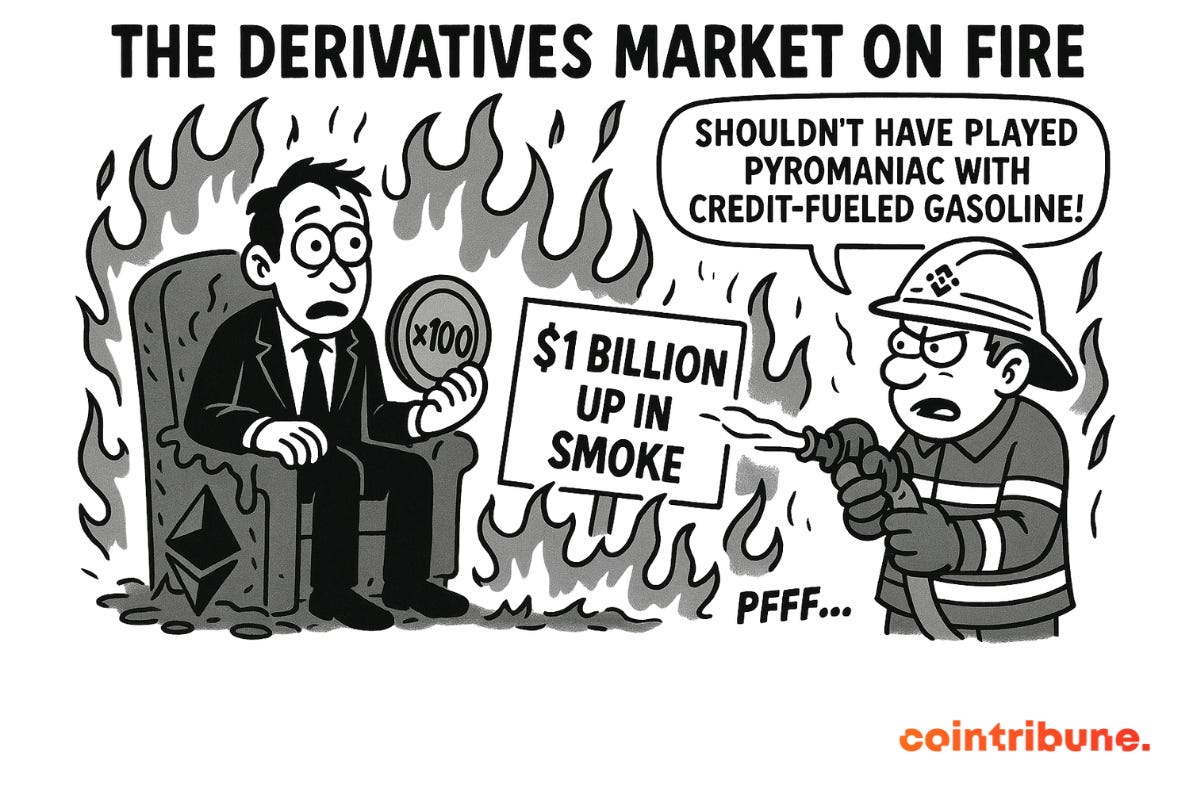
✍️ Cartoon of the day:
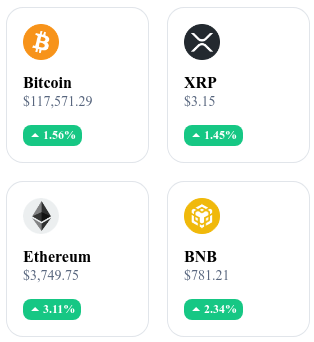
A quick look at the market…
🌡 Weather:
🌧️ Rainy

24h crypto recap! ⏱
💵 Anchorage Digital and Ethena Labs Launch the First Stablecoin Compliant with the GENIUS Act
Anchorage Digital Bank issues in the United States the stablecoin USDtb, developed by Ethena Labs, through its platform compliant with the reserve, audit, and transparency requirements introduced by the recently passed GENIUS Act. This launch makes USDtb the first stablecoin to benefit from a clear legal framework, thus strengthening the institutional credibility of the American crypto sector.
🤖 Nearly 67% of Young Traders Bet on AI to Reduce Volatility
According to a MEXC study, 67% of Gen Z traders use artificial intelligence tools during volatile sessions, reducing panic selling by 47% compared to manual traders. AI is thus perceived as an "emotional co-pilot", allowing a more rational and disciplined management of crypto positions, especially on Bitcoin and Ethereum.
🏦 Société Générale Strengthens Trading of 21Shares Crypto ETPs in Europe
In partnership with 21Shares, Société Générale becomes a market maker for Bitcoin (ABTC, CBTC) and Ethereum (AETH, CETH) ETPs on German and Eastern European platforms. The goal is to improve liquidity and reduce execution spreads to make these products more accessible to institutional investors.
📉 Nearly One Billion USD Liquidated in 24h: The Impact of Derivatives on Altcoins
The crypto derivatives market suffered more than 967 million USD in liquidations in 24h, mainly on long positions. XRP and Dogecoin fell by nearly 10%, followed by Ethereum and Solana, once again showing the fragility of altcoins during harsh corrections. They have since started to recover…
🤖 Create a trading bot without coding thanks to Runbot
Runbot offers a no-code platform that allows users to build a trend-following crypto bot compatible with Ethereum and BNB Chain, accessible even to non-technical users. The tool lets you configure signals, entries/exits, stop-losses, and trailing, while remaining transparent through backtested performance on historical market data.

Crypto of the Day: Hedera (HBAR)
🧠 What Innovation? What Added Value?
Hedera Hashgraph relies on a sophisticated consensus algorithm called Hashgraph, based on a gossip-about-gossip mechanism and virtual voting, guaranteeing instant finality transactions without forks. Capable of more than 10,000 TPS, it aims for reliable large-scale performance.
Optimized for professional use cases (micropayments, supply chains, digital identity), Hedera stands out by its governance orchestrated by a board of renowned enterprises (Google, IBM, Boeing). This unique configuration makes it a public, secure platform designed from its inception to support institutional adoption.
💰 The HBAR Token: Utility, Distribution, and Benefits
The HBAR token plays a key role in the Hedera ecosystem:
It allows to pay transaction fees, extremely low even for micropayments.
It is used for staking by validators, ensuring the security and robustness of the network.
It serves as the main tool for economic incentives to attract developers and businesses.
Its initial distribution was carried out through institutional partnerships and public sales, with a cap of 50 billion HBAR.
📊 Recent Performance (Last 24 Hours)
Current Price : $0.2662 USD
24h Change : +11.35%
Market Capitalization : ≈ 11.29 billion $ USD
CoinMarketCap Rank : #15
Circulating Supply : 42,392,669,988 HBAR
24h Trading Volume : ≈ 1.03 billion $ USD

Are Your Bitcoins Threatened by Quantum Computing?
Quantum computing, long confined to research laboratories, could soon shake the foundations of Bitcoin network security. A technical study conducted by ChainCode Labs reveals a potentially significant vulnerability: nearly a third of existing bitcoins could be compromised if quantum advances materialize. The analysis, presented at the Quantum Bitcoin Summit, raises major technical, ethical, and community issues for the ecosystem.
A Massive Vulnerability Revealed by ChainCode Labs
ChainCode Labs estimates that 32.7% of bitcoins are currently vulnerable to a potential quantum attack. This represents about 6.36 million BTC, a considerable volume spread across different types of transaction outputs.
The most significant risk concerns UTXOs resulting from address reuse: 103 million outputs for a total of 4.49 million BTC are affected. In these cases, the public key is revealed following a transaction, exposing the current ECDSA cryptography to compromise as soon as quantum computers achieve the ability to break this cryptographic scheme.
Added to this threat are 1.87 million BTC deposited in P2PK scripts, where the public key is visible by default, and about 150,000 BTC held via P2TR (Taproot) transactions, considered slightly less vulnerable but still at risk according to current hypotheses.
Protection Avenues but Community Debate Still Open
Faced with this potential threat, solutions are under study, but none yet enjoy consensus. Jameson Lopp, an active member of the Bitcoin community, proposes freezing vulnerable bitcoins before an attacker can steal them thanks to sufficient quantum computing power. This freeze would consist of blocking upstream UTXOs whose public keys are already revealed, preventing their future unauthorized spending.
Such a proposal raises important ethical and technical debates. It would set a precedent in Bitcoin protocol governance, traditionally hostile to any form of intervention on consensus rules. It would also be difficult to accept by advocates of absolute immutability.
At the same time, several technical proposals are trying to prepare Bitcoin for the quantum era. BIP-360, currently under discussion, aims to facilitate migration to new, more robust cryptographic schemes. Other researchers explore adopting post-quantum addresses capable of resisting an attack by Shor's algorithm. To learn more about these approaches, you can discover the cryptographic alternatives studied by the community.
The community remains divided on the real urgency of the danger. Some believe that sufficiently powerful quantum computing will not emerge for several decades. Others, more cautious, consider that a state-level adversary might already have such a tool and wait for the right moment to exploit it discreetly. The implications of this uncertainty are major and justify continuous monitoring of advances in this field.
