



Hello Cointribe! 🚀
Today is Friday, July 18, 2025 and like every day from Tuesday to Saturday, we summarize for you the news from the last 24 hours that you should not have missed!
But first…
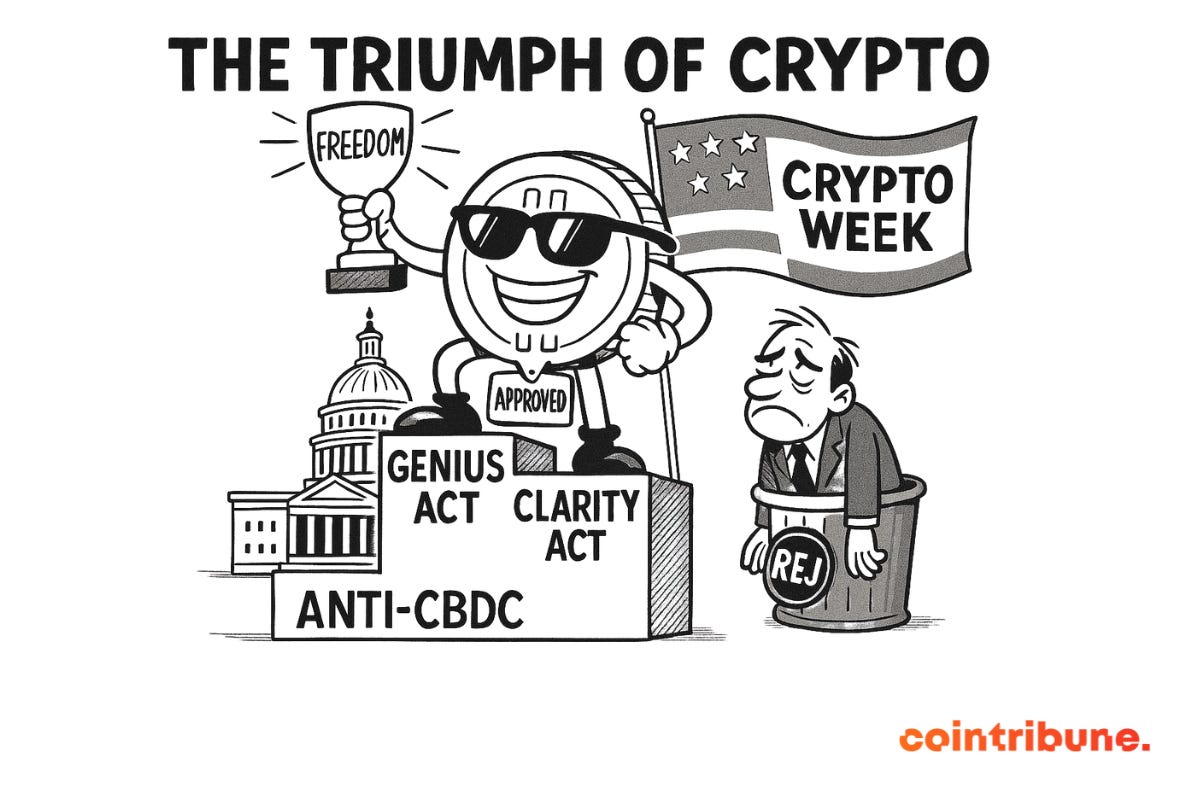
✍️ Cartoon of the day:
A quick look at the market…
🌡 Weather:
☀️ Sunny
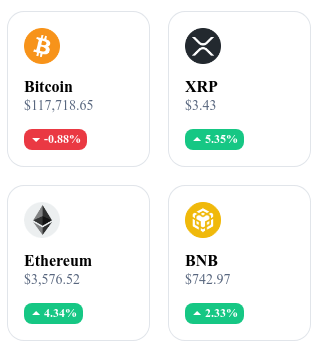

24h crypto recap! ⏱
🇺🇸 Three American laws redefine crypto
The U.S. House of Representatives has passed three strategic laws: the GENIUS Act which regulates stablecoins, the CLARITY Act which sets competencies between the SEC and the CFTC, and the Anti-CBDC Act which prohibits the creation of a federal digital dollar. These texts mark a historic change in crypto regulation in the United States.
🤝 Pakistan and El Salvador build a Bitcoin alliance
Pakistan and El Salvador have concluded a cooperation agreement in crypto, which notably provides for the allocation of 2,000 MW of energy to Bitcoin mining and the establishment of a national reserve. This initiative still needs the approval of the IMF, which is closely observing the energy and economic implications.
🧭 Europe strengthens crypto actors' surveillance
The European Union has implemented stringent requirements through AMLA: the ban on anonymous wallets, direct monitoring of ultimate beneficiaries, and immediate access to client data. This new regulation complements MiCA and marks a decisive step toward intensive supervision of the crypto industry.

Crypto of the day: Aptos (APT)
🧠 What innovation? What added value?
Aptos is a layer 1 blockchain designed to deliver cutting-edge performance, combining high speed, reliability, and security. Derived from the initial work of the Diem project (formerly Meta’s Libra), it is based on the Move language, specially designed to enhance smart contract security.
Aptos’s architecture relies on a parallel execution model (Block-STM), which allows simultaneous processing of multiple transactions, significantly reducing wait times while increasing throughput. Unlike Ethereum or Solana, which handle transactions sequentially or semi-parallel, Aptos targets a transaction finality under one second.
Thanks to a consensus mechanism based on proof of stake combined with the Byzantine Fault Tolerance (BFT) protocol, the network guarantees both resilience and energy efficiency. This technological combination makes Aptos an infrastructure tailored to host large-scale complex Web3 applications, ranging from decentralized finance (DeFi) to blockchain gaming and digital identities.
💰 The native crypto: What utility? What advantages?
The APT token plays a central role in the Aptos ecosystem. It was initially distributed via a community allocation, an airdrop for early users, and private sales to institutional investors. The total supply is capped at 1 billion tokens.
The utility of the token rests on four key areas:
It is used to pay transaction fees on the Aptos network.
It enables securing the blockchain via staking, incentivizing validators to maintain network integrity.
It grants governance rights, allowing holders to vote on protocol developments.
It promotes dApp adoption, serving as an economic gateway between developers and users.
The combination of these functions strengthens the robustness of the Aptos ecosystem while offering financial and decision-making incentives to network participants.
📊 Recent performance (data as of July 18, 2025)
Current price: $5.58 USD
24-hour change: +6.95%
Market capitalization: $3.55 billion
Rank on CoinMarketCap: #34
Circulating supply: 654,681,972 APT
24h trading volume: $380.2 million

Bitcoin in 2025: TD Cowen's forecasts
Bank TD Cowen reveals a new series of projections for bitcoin by the end of 2025, highlighting the growing impact of institutional investors and the rapid evolution of the regulatory framework in the United States. These estimates, anchored in a context of massive adoption and clarified regulation, come as actors like Strategy redouble their ambition to accumulate BTC on a large scale. Analysis of a paradigm shift.
Three trajectories for bitcoin according to TD Cowen
The central scenario presented by TD Cowen positions bitcoin at $128,000 by December 2025. This estimate is based on a bullish dynamic fueled by the progressive entry of institutional investors, now the engines of flows on crypto markets. For the bank, this level reflects a normalization of BTC exposure in institutional portfolios, facilitated by the rise of derivative financial products like spot ETFs.
TD Cowen also envisages two variants: a bullish scenario at $155,000, conditioned on smooth regulatory adoption and the absence of macroeconomic shocks; and a bearish scenario at $55,000 in case of prolonged monetary tightening, global economic slowdown, or disengagement of major actors.
For comparison, several competing institutions have even higher targets. Standard Chartered, Bernstein, or Bitwise expect $200,000, while Galaxy Digital and VanEck mention $180,000. Meanwhile, Fundstrat anticipates up to $250,000 if the United States establishes a strategic bitcoin reserve.
The adoption of crypto laws triggers an institutional turning point
The American regulatory landscape shifted overnight with the formal adoption of the GENIUS Act, CLARITY Act, and FIT21 laws. These texts, now enacted, establish a clear legal framework for crypto assets, clarify the respective roles of the SEC and CFTC, and end years of regulatory ambiguity. For TD Cowen, this legal advance should accelerate the bullish scenario to $155,000: it removes a major barrier to institutional capital entry.
The combination of stabilized legal framework and aggressive accumulation strategies fuels the thesis of a self-sustaining bullish spiral. Newly arrived institutional actors, now legally covered, could generate structural demand far exceeding the issuance capacity of the Bitcoin network. From this perspective, projections of $200,000 or more, once deemed optimistic a few months ago, now seem better grounded in reality.
