



Hello Cointribe! 🚀
Greetings, crypto crew! 👋 Here’s a quick digest of the crypto market for Thursday, February 5, 2026, covering the most important moves and key news from the past 24 hours.
But first…
✍️ Cartoon of the day:

A quick look at the market…
🌡 Weather:
⛈️ Stormy
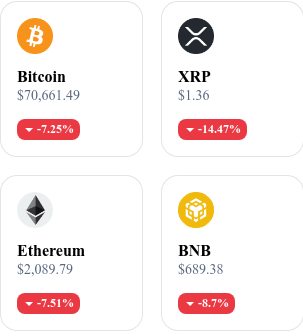

24h crypto recap! ⏱
📈 Standard Chartered Revises Solana’s 2026 Price Target
Standard Chartered has lowered its Solana (SOL) end-of-2026 price forecast to $250, explaining the adjustment with structural shifts in network activity and a slower conversion of technical strengths into revenue. Analysts see SOL moving from memecoin speculation toward stablecoin-based micropayments and other real-use cases, though the network may underperform Ethereum in the near term. The bank still highlights Solana’s long-term potential and ultra-low fees supporting future growth.
👉 Read the article
⚡ Stablecoins Process $10 Trillion, Setting Monthly Record
In January 2026, stablecoins processed $10 trillion in transactions, an unprecedented monthly total that contrasts with Bitcoin’s recent price weakness. Circle’s USDC accounted for the largest share—about $8.4 trillion—with Tether and DAI also contributing heavily. This record volume represents roughly one-third of all stablecoin activity in 2024, reflecting massive on-chain liquidity flows. The surge suggests investors are strategically positioning capital and fuels debate about stablecoins’ evolving role in markets.
👉 Read the article
⚖️ Nevada Sues Coinbase Over Prediction Markets
Nevada’s Gaming Control Board has filed a civil enforcement action against Coinbase Financial Markets, alleging it operates unlicensed wagering services through its recently launched prediction markets. Regulators argue that event-based contracts tied to sports and other outcomes fall under state gambling laws requiring a license. Coinbase disputes this, saying the products are regulated under federal commodities law, and has filed lawsuits against other states defending national regulatory consistency.
👉 Read the article
🔄 Family Offices Favor AI Over Crypto, JPMorgan Says
According to JPMorgan’s 2026 Global Family Office Report, about 89% of family offices globally currently hold no cryptocurrency exposure, while 65% are prioritizing investments in artificial intelligence (AI) as a top theme. Average allocation to digital assets remains very low, with crypto seen as speculative and riskier. The shift underscores how ultra-wealthy private investors are recalibrating portfolios toward AI, private equity, venture, and other growth areas.
👉 Read the article
🏛️ U.S. Congress Passes Stopgap Budget to Avert Extended Shutdown
The U.S. Congress narrowly passed a temporary federal budget to avoid a prolonged government shutdown, ending a short lapse in funding that had paused many public services. The House approved a roughly $1.2 trillion bill, which was signed into law, keeping most agencies funded through September 30. However, the Department of Homeland Security’s funding was extended only briefly, setting up new political battles if longer agreements aren’t reached.
👉 Read the article

🔷 Crypto of the Day: Ethereum (ETH)
Ethereum Transfer Count Surges, Raising Market Caution
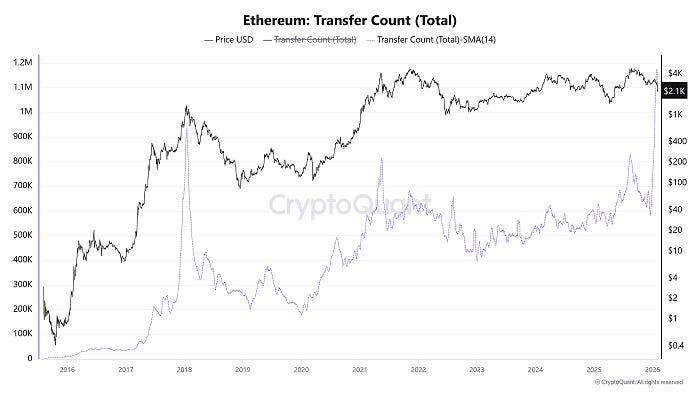
Ethereum, the world’s second-largest cryptocurrency, has been under pressure for several weeks. Despite this downtrend, new on-chain data suggests traders should remain alert. According to a contributor on CryptoQuant, Ethereum’s total transfer count—smoothed over a 14-day simple moving average (SMA)—spiked to 1.17 million on January 29, 2026. Such a sharp increase in network activity often signals heightened market attention and can precede periods of elevated volatility.
Historical Patterns Signal Risk
Past trends show that sudden surges in Ethereum transfer counts have occurred during critical market pivots. For example, spikes in 2018 and 2021 were followed by notable price corrections. While increased transfer activity can indicate adoption, exceptionally steep rises often suggest large holders or institutional investors are moving funds, potentially to exchanges, which can signal profit-taking and market overheating.
Key Observations
The recent spike closely resembles past peaks seen in January 2018 and May 2021.
High transfer counts often indicate distribution by long-term holders or smart money.
Sudden surges can coincide with extreme price volatility and local market tops.
On-chain activity suggests the market is currently in a zone of higher risk.
Implications for Traders
Ethereum’s current transfer activity, highlighted by the CryptoQuant contributor, indicates that caution may be warranted. While the broader macro environment differs from previous cycles, the on-chain behavior hints at a potential short-term correction. Investors should watch transfer trends closely, as these movements may foreshadow increased market volatility in the near future.
📊 Real-time Performance (CMC)
💵 Current Price: $2,065.93
📉 24h Change: -7.7%
💰 Market Capitalization: $249.87B
🏅 CoinMarketCap Rank: #2
🪙 Circulating Supply: 120.69M ETH
📊 Trading Volume (24h): $54.06B

🔥 XRP in the “Washout Zone”: Deep Correction or Hidden Opportunity?
As the broader crypto market flirts with uncertainty, XRP has become a focal point for analysts. According to Elliott Wave specialist XForceGlobal, the token has entered what he calls a “washout zone”—a phase of intense correction that could signal a significant shift in trend rather than just another drop.
📉 What Is This “Washout Zone”?
In his analysis, XForceGlobal interprets recent price action as part of a Wave C corrective structure, a stage often driven by panic selling and emotional exits. This phase is thought to flush out weak positions and remove excess speculative pressure before a clearer trend can emerge.
He argues this isn’t just random selling—it’s part of a cyclical market pattern where a deep pullback ultimately sets up a stronger foundation for future gains. In this view, the washout isn’t necessarily a sign of total capitulation, but rather a necessary purge in order to clear the way for healthier upside later.
📊 Analyst’s Bullish Case: Looking Beyond the Dip
Under this scenario, once the corrective structure finishes, XRP could shift into a new impulsive phase. If this broader pattern plays out, XForceGlobal suggests long-term targets in the $20–$30 range, implying a multi-wave rally that unfolds over time.
To support this, he highlights several technical features that may mark the washout phase:
Emotional selling intensifies, driving prices lower as investors exit positions.
Stop-loss triggers compound selling at key levels, amplifying the drop.
Fibonacci ratios suggest deep correction potential, often seen at the end of major sell-offs.
Accumulation zones form near lower supports, creating areas where buyers may re-enter.
💡 Mixed Signals: Not All Analysts Agree
However, the story isn’t entirely bullish. Other technical indicators paint a more cautious picture:
Some traders note a bear pennant pattern, which can signal continued downside momentum rather than reversal.
XRP breaking below key levels like $1.50 could mean deeper support tests—possibly toward around $1.22—before any reversal confidence emerges.
Declining open interest across derivatives may hint that selling pressure is easing, but without fresh capital inflows, this could simply signal short-term stagnation.
⚖️ So, Should You Worry?
The answer depends on one’s perspective:
Optimists see today’s washout as a cleansing phase that could precede a long-term uptrend.
Skeptics focus on bearish patterns and emphasize waiting for clear confirmation before assuming any rebound.
What’s certain is that XRP’s current behavior reflects market indecision and technical complexity, with both strong correction mechanics and intriguing recovery signals coexisting. Investors are watching price action closely, aware that upcoming moves could validate either narrative.
